

Nylon Bars or Self-Lubricating Plastic: Which Material Should You Choose for Moving Parts?
Article originally appeared on https://blog.igus.mx/barras-de-nylon-o-plastico-autolubricante-que-material-elegir-para-piezas-en-movimiento/
When a special part needs to be manufactured, nylon bars and other engineering plastics are often a practical alternative to metal.
They can be cut, turned, or milled to produce bushings, rollers, pulleys, gears, guides, and wear plates. They also make it possible to manufacture custom parts without developing a mold.
However, not all plastic bars were designed to work under the same conditions.
A material can offer good mechanical strength and perform well in a structural part, but behave differently when it must slide constantly against a shaft or withstand thousands of movement cycles.
For that reason, before choosing between a nylon 6 bar and a self-lubricating plastic, it is worth analyzing what the part will actually do inside the machine.
What is nylon 6?
Nylon 6, also known as polyamide 6 or PA6, is one of the most widely used engineering plastics for manufacturing industrial parts.
It is characterized by a combination of mechanical strength, stiffness, hardness, and impact-absorption capacity. It can also help reduce weight and noise compared with some metal components.
Because of these characteristics, nylon bars and plates are commonly used to manufacture:
- Gears.
- Pulleys.
- Rollers.
- Wheels.
- Bushings.
- Structural components.
- Machine parts manufactured in small quantities.
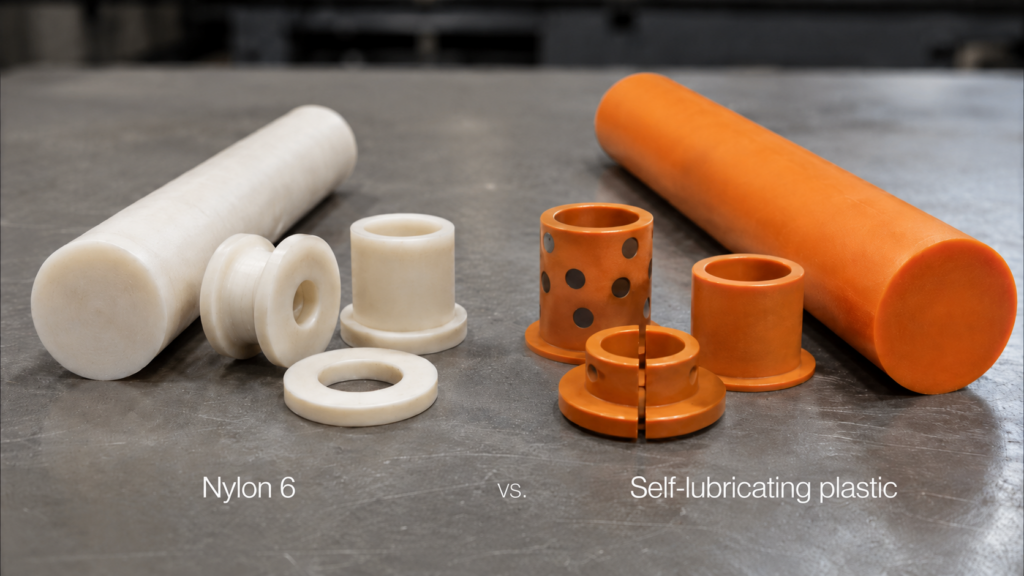
Different nylon formulations exist. Some incorporate oil, solid lubricants, or other additives to improve their behavior against wear or friction.
For that reason, not all nylons offer exactly the same performance.
When might a nylon bar not be enough?
One of the most common mistakes when selecting a plastic bar is to focus only on its hardness, price, or load-bearing capacity.
These properties are important, but they do not always tell the whole story.
When a part will be in motion, other factors must also be considered:
- The type of movement.
- The speed.
- The load.
- The friction.
- The material of the shaft or mating surface.
- The presence of dust or moisture.
- The need for lubrication.
- The frequency of maintenance.
For example, a bushing may support the load of an application perfectly well and still generate too much friction against the shaft.
A guide can be strong, yet slightly change its dimensions as it absorbs moisture.
A roller may work correctly during the first few months but require frequent lubrication to avoid accelerated wear.
In these cases, the question should not only be “how strong is the material?” but also “how will it behave after thousands or millions of movements?”
Self-lubricating plastics for parts with friction and movement
Tribologically optimized plastics are developed specifically to work in applications where there is contact, friction, and movement.
Although the phrase “tribologically optimized” may sound complicated, the concept is simple: these are materials designed to control wear and facilitate sliding between surfaces.
iglide® bars and plates, for example, combine base polymers, reinforcing fibers, filler materials, and solid lubricants distributed throughout the material itself.
Each element serves a function:
- The polymers provide wear resistance.
- The fibers help support loads.
- The solid lubricants reduce friction during movement.
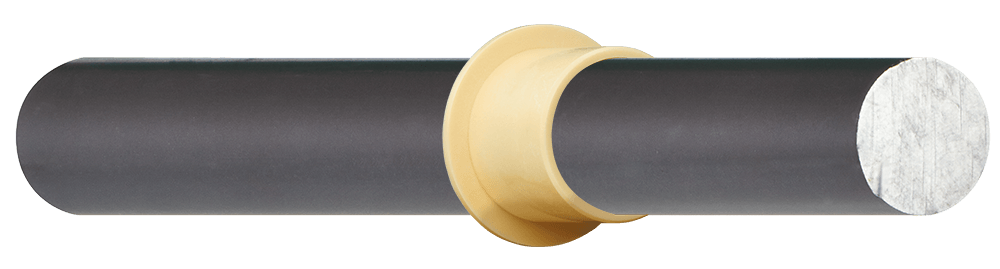
This makes it possible to machine bushings, guides, rollers, and other special parts that can operate dry, without relying on a layer of grease applied afterward.
The difference is not simply using plastic instead of metal. It lies in using a material developed from the outset to become a moving part.
Advantages of using a self-lubricating plastic
Working without external lubrication can change more than it might seem inside a machine.
It does not just eliminate the use of grease or oil. It can also reduce maintenance tasks, lubrication points, production interruptions, and human error.
Consider a guide that operates inside a machine exposed to dust or debris.
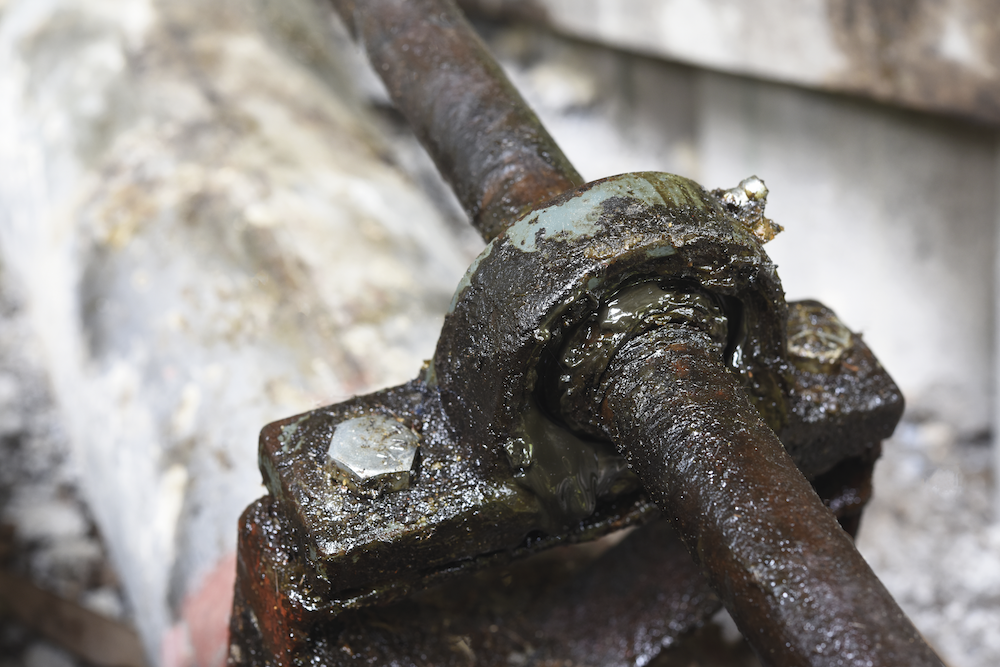
If the surface is covered in grease, particles can stick to it and form an abrasive mixture that accelerates wear. A part designed to run dry prevents the lubricant from becoming a point where dirt accumulates.
In a food, beverage, or packaging machine, eliminating external lubrication can also make cleaning easier and reduce the risk of contamination in sensitive areas.
This does not mean a self-lubricating plastic is always the best option. It means it can be more appropriate when movement and wear are important factors in the application.
How does moisture affect nylon 6?
Nylon is a hygroscopic material, meaning it can absorb moisture from the environment.
The amount depends on the formulation, the temperature, and the operating conditions. However, this absorption can cause dimensional changes and alter some of the material's properties.
This should be considered especially when a part:
- Works in humid environments.
- Is in frequent contact with water.
- Is cleaned constantly.
- Needs to maintain tight tolerances.
- Slides on a shaft with little available clearance.
Imagine a bushing machined to a very precise tolerance.
If the material absorbs moisture and its size increases slightly, the bushing could tighten against the shaft and generate more friction. If the dimensions change in the other direction, clearance could increase instead.
On a large pulley or a wear plate with generous tolerances, this change may not be a significant problem. On a bearing, a guide, or a dosing system, it can be decisive.
Among tribological plastics there are materials with different levels of moisture absorption. This makes it possible to choose a formulation suited to the environment instead of using the same material for every application.
Related: How does moisture affect plain bearings?
Differences between nylon 6 and self-lubricating plastics
Nylon 6 can be understood as a versatile engineering plastic, with good mechanical properties and very diverse applications.
Self-lubricating plastics follow a different logic: their formulation is selected according to the movement, friction, and operating conditions involved.
| Aspect | Nylon 6 | Self-lubricating plastic |
|---|---|---|
| Primary use | General mechanical parts | Components with friction and movement |
| Mechanical strength | Generally high | Depends on the material selected |
| External lubrication | May be necessary depending on the application | Designed to run dry |
| Moisture | Can absorb it and change dimensionally | Low-absorption options are available |
| Maintenance | Depends on the part and application | Can reduce lubrication tasks |
| Common applications | Pulleys, gears, rollers, and structural parts | Bushings, guides, slides, and wear plates |
| How material is selected | General mechanical properties | Load, movement, temperature, and environment |
This comparison is a general guide. Actual performance will always depend on the specific formulation, the geometry of the part, and the real operating conditions.
Three examples to better understand the difference
1. A large pulley subject to impacts
When a part needs to be robust, machinable, and have good mechanical properties, nylon 6 can be a suitable alternative.
Its strength and impact-absorption capacity make it useful for pulleys, gears, and larger components.
In this application, structural strength may be more important than achieving the lowest possible level of friction.
2. A bushing that runs constantly dry
If the component will be in motion for extended periods and will be difficult to lubricate, a self-lubricating plastic may be more convenient.
Here it is not enough for the bushing to just support the load — it must also slide correctly on the shaft, keep wear under control, and avoid frequent maintenance interventions.
3. A guide inside a packaging machine
In an area exposed to cleaning, moisture, dust, or close contact with food, material selection must take more variables into account.
Beyond withstanding movement, the part may need low moisture absorption, chemical resistance, or compliance with specific industry requirements.
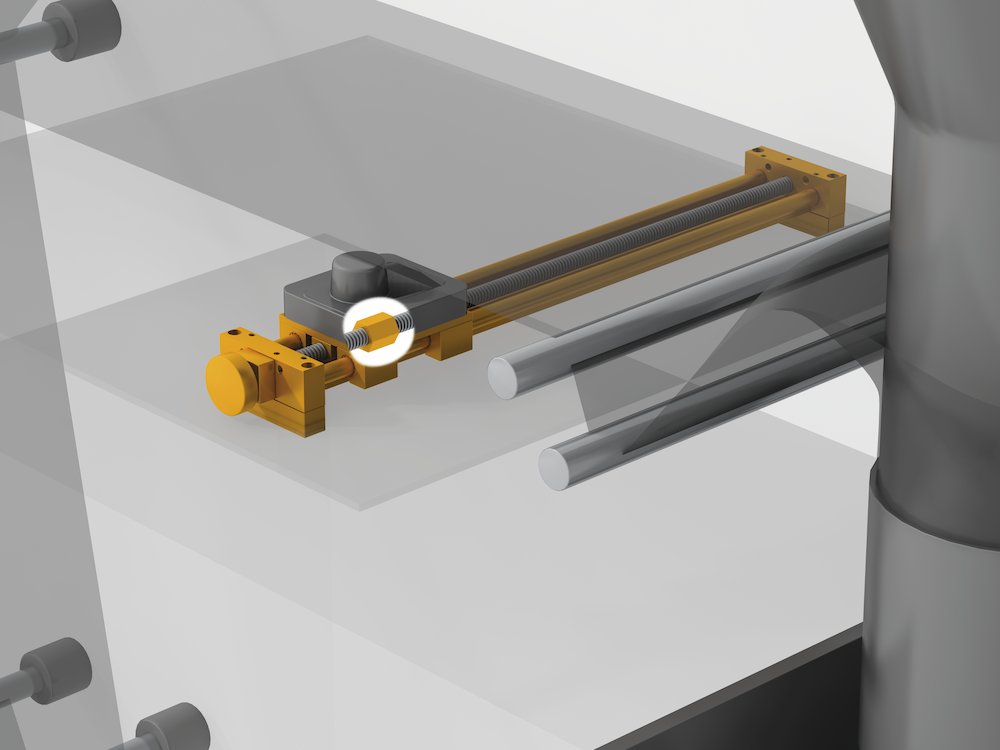
In these cases, using a material developed for those conditions can offer an advantage over selecting a bar based on mechanical strength alone.
Related: Robotic packaging: the essential guide
When should you choose nylon, and when a self-lubricating plastic?
A nylon 6 bar can be a good alternative when you need parts that are strong, machinable, and intended for general mechanical use.
It can also be appropriate for large gears, pulleys, rollers, and components where load or impact absorption are the main criteria.
A self-lubricating plastic makes more sense when the application presents one or more of the following conditions:
- There is constant contact between surfaces.
- The part will undergo rotary, linear, or oscillating movement.
- The goal is to operate without grease or oil.
- Maintenance is difficult or costly.
- Dust, dirt, or moisture are present.
- Low levels of friction and wear are required.
- The part must maintain precise tolerances.
- There are hygiene, temperature, or chemical-resistance requirements.
- Prototypes or special parts are needed in small quantities.
The best option is not always the material with the lowest initial price.
Wear, lubrication tasks, maintenance downtime, expected service life, and how often the part will need to be replaced should also be evaluated.
Choosing the right material starts with understanding the application
There is no single plastic bar that is ideal for every part.
Nylon 6 offers clear advantages in general mechanical applications, larger parts, and components subject to impact.
Self-lubricating plastics, in turn, make it possible to address the friction, wear, moisture, and maintenance problems that arise in moving parts in a more targeted way.
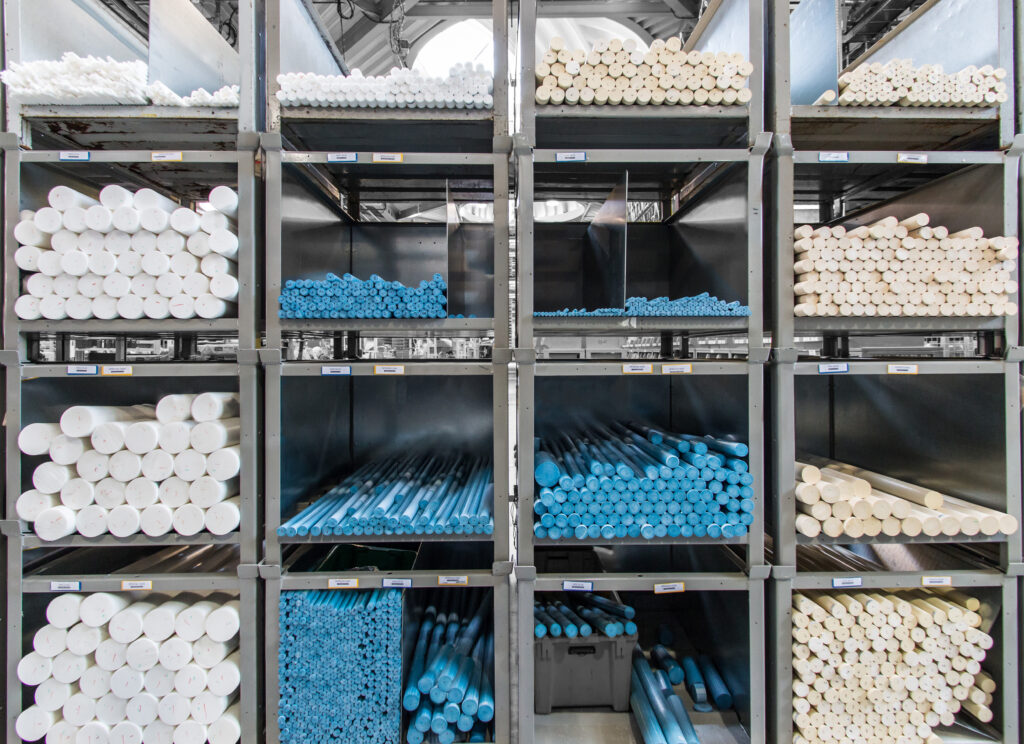
Before choosing, it is worth reviewing the load, the type of movement, the speed, the shaft material, the environmental conditions, and the need to operate without lubrication.
Are you currently manufacturing a part in nylon, metal, or another plastic? Check out iglide plastic bars and plates from igus® and find a suitable material for the real movement, wear, and operating conditions of your application.