
How lead screws improve pick-and-place accuracy in packaging robots
Packaging lines are judged on where a product lands, not just on how fast it gets there. PMMI research found that manufacturing managers at consumer packaged goods companies rate their packaging machinery as more downtime-prone than the other machine types in their plants. A TeepTrak benchmark across more than 120 pharmaceutical packaging lines gives that a shape. Availability losses run near 22 OEE points, and micro-stops account for seven of them on their own. Those are the short, repeated stoppages that follow a jam or a part that landed slightly off.
Delta robots take the attention. Much of the precision work happens in the linear motion around them: the drives that center an infeed guide, set a camera height, or lower a gripper onto a carton. This article covers where lead screws belong in a packaging cell, why they hold position, and how they fit into a complete pick-and-place system.
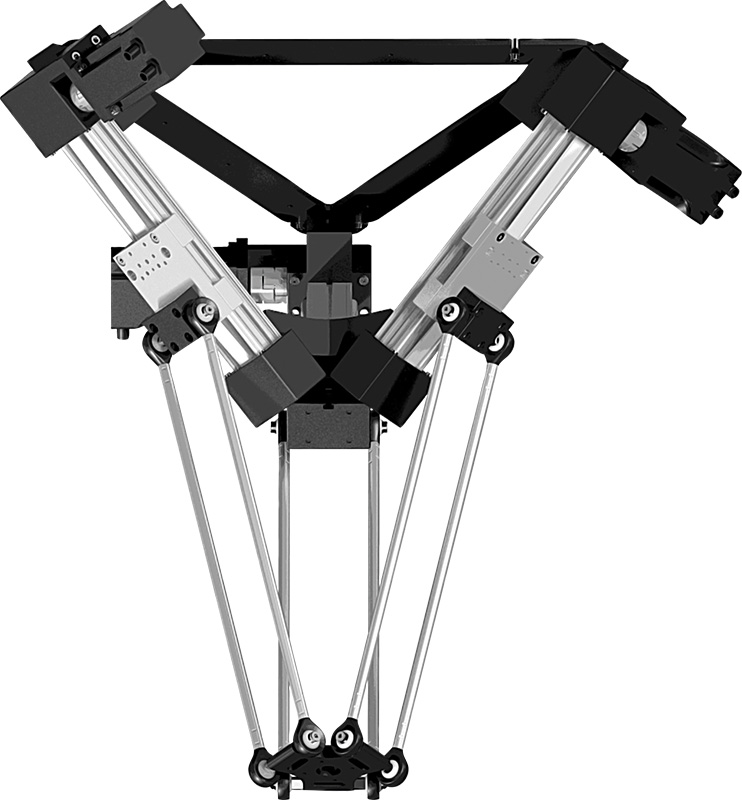
Why accuracy matters in pick-and-place packaging
A pick-and-place head may need to seat a product in a tray pocket, align a cap over a bottle neck, or stack cases into a pallet pattern. Each task carries a tolerance, and a miss rarely stays local. A crushed carton flute jams the case erector. A cross-threaded cap stops the capper and backs product up the line.
Accuracy and repeatability are not the same requirement. Accuracy means reaching the commanded position once. Repeatability means reaching it again after ten thousand cycles, from either direction of travel. Packaging machines live on the second one — a placement validated at start-up has to still be valid at the end of the shift.
Positioning quality shows up in four places on the plant floor:
- Product quality: consistent seating and alignment, with fewer defects traced back to a misplaced pick.
- Throughput: a machine that can trust its own position runs closer to its rated speed, without corrective moves or added verification steps.
- Scrap: damaged packaging and rejected product both start as a positioning error.
- Uptime: collisions with tooling pull an operator to the line and stop the run.
Where do lead screws fit in a packaging cell?
When engineers picture motion in a packaging machine, the robot arm comes first. Many of the positions that govern placement accuracy, though, are set elsewhere — by hardware that moves once per format change and then holds. Lead screw assemblies suit that duty. A screw and nut convert motor rotation into a defined amount of travel, and the assembly stays where it stops.
The screw does not have to drive the whole robot to earn its place in the design:
- Infeed positioning: center or square products before the pick point.
- Conveyor width adjustment: move side rails to match a new carton width.
- Camera and lighting alignment: set standoff distance and angle for the vision system.
- End-of-arm tooling: shift gripper fingers or vacuum cups for a different product footprint.
- Gripper height: hold pickup height above the belt across product formats.
- Gantry drive: carry the tool itself along a linear actuator.
Automated changeover is the largest opportunity in that list. Servo-driven changeover is usually applied at exactly these screw-type adjustment points. Machine builders including AFA Systems report full format changes in under five minutes on a case packer or carton former. Instead of loosening handwheels and measuring guides by eye, an operator selects a stored recipe and each adjustment point drives itself to position.
The trade-off is real. Motors, motor controllers, and gearboxes add cost and add failure points, and some positions cannot be driven at all — a cartoner magazine, for one. A machine running two formats rarely earns the investment, while one running twelve usually does.
Why lead screws hold position accurately
Predictable travel per revolution
The lead of the screw sets how far the nut moves per turn. Paired with a stepper motor, the control system knows the distance for every commanded step, with no belt in between to stretch or slip. Engineers size the lead against the required force, speed, and resolution: a shorter lead trades speed for resolution, and a longer one does the reverse.
Low backlash through direction changes
Backlash is free play between screw and nut when travel reverses. Too much, and the head approaches a target from a slightly different place depending on which way it arrived. Too little clearance, and the assembly binds and wears early. Preloaded nuts sit between those extremes, holding the tool to one coordinate whichever direction it approaches from.
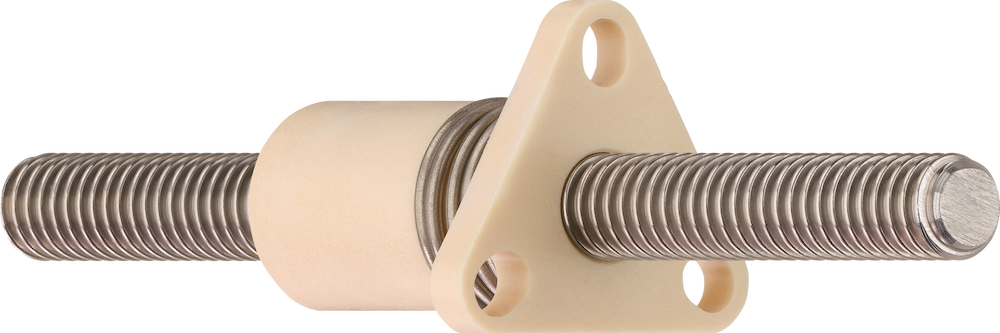
Resistance to back-driving
Vertical moves raise a second question: what holds the load when the motor is unpowered? Depending on lead angle, friction, and load, a lead screw assembly resists back-driving and holds position without a brake, where a belt drive usually needs added holding hardware. Back-driving behavior is application-dependent, so confirm it against the specific assembly rather than assuming it.
What makes dryspin® lead screw technology different
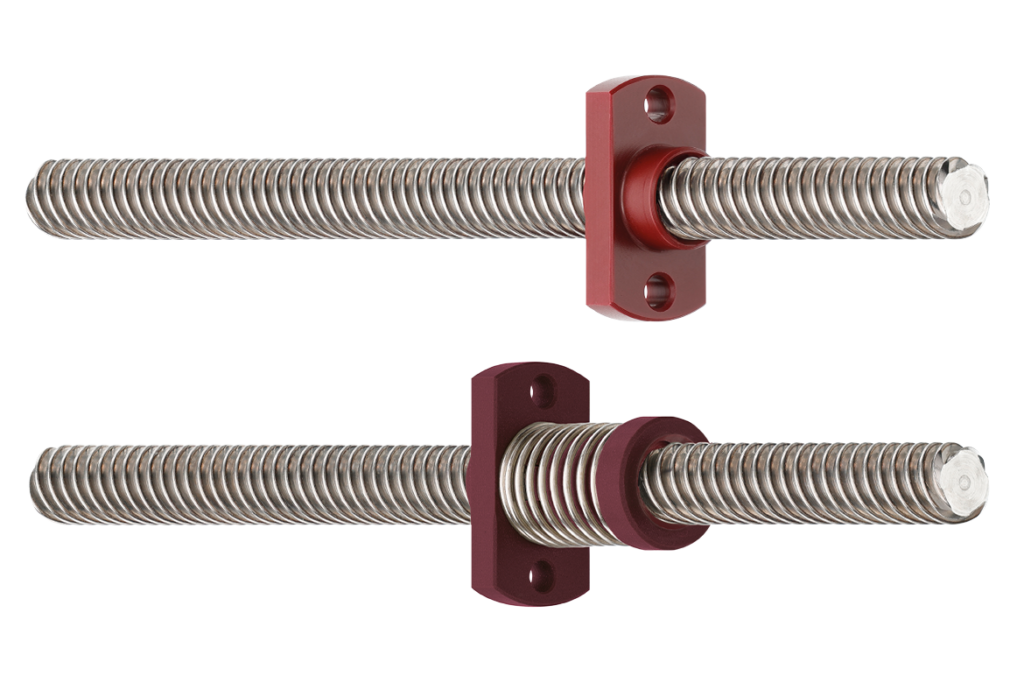
A lead screw is only as maintenance-friendly as the pairing between screw and nut. dryspin® technology from igus® combines a high-helix thread geometry with self-lubricating iglide® polymer nuts, so the nut carries solid lubricant inside the bearing material itself. No grease line and no relubrication interval — and no lubricant working its way toward product contact surfaces.
Thread geometry does the other half of the work. Flattening the thread angle raises the efficiency rating by about 8 percent against a standard trapezoidal 10×3 screw. A flatter helix converts more of the applied force into linear travel, so a smaller motor moves the same load.
The same profile change pays off in wear. Enlarging the thread flank puts more high-performance polymer where the load is carried, and igus reports roughly 30 percent more service life than a symmetrical trapezoidal thread.
Material choice pays off in washdown areas. Polymer nuts and stainless steel screws resist corrosion, and dry-running surfaces give the cleaning crew nothing to wash out and nothing to reapply afterward. The polymer-on-metal pairing also runs quieter than metal on metal, which makes an abnormal noise easier to pick out on a busy floor.
Nut wear is gradual rather than sudden. Service life depends on load, speed, temperature, duty cycle, and contamination, and those inputs feed published service-life calculations. A calculated wear rate turns nut replacement into a scheduled task instead of a breakdown.
Building the complete linear actuator
The screw drives the load, but it does not guide it. A working actuator brings together:
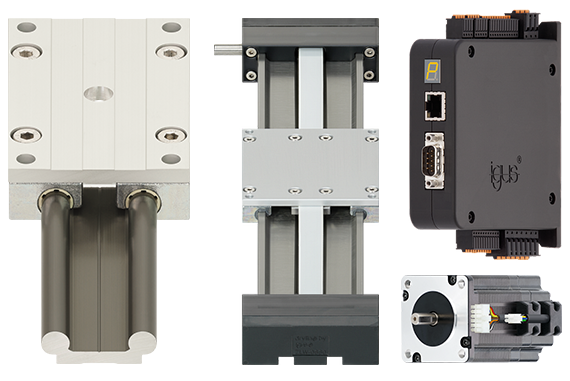
- dryspin lead screw assemblies for the drive itself
- drylin® linear guides to carry side loads and moments
- drylin linear actuators where a pre-built unit beats a custom assembly
- NEMA stepper motors sized to the load and duty cycle
- dryve D1 motor controllers to set motion profiles and homing behavior
Combining lead screws with gantry robots on the RBTX Marketplace
One actuator solves an adjustment. A pick-and-place task needs several working together. A Cartesian gantry builds X, Y, and Z travel from linear actuators, and it stays simpler to program, guard, and troubleshoot than an articulated arm.
The RBTX machine planner lets engineers configure that system online. Actuators, motors, motor controllers, grippers, and vision hardware are selected against travel, payload, and cycle time, then checked for compatibility before anything is purchased.
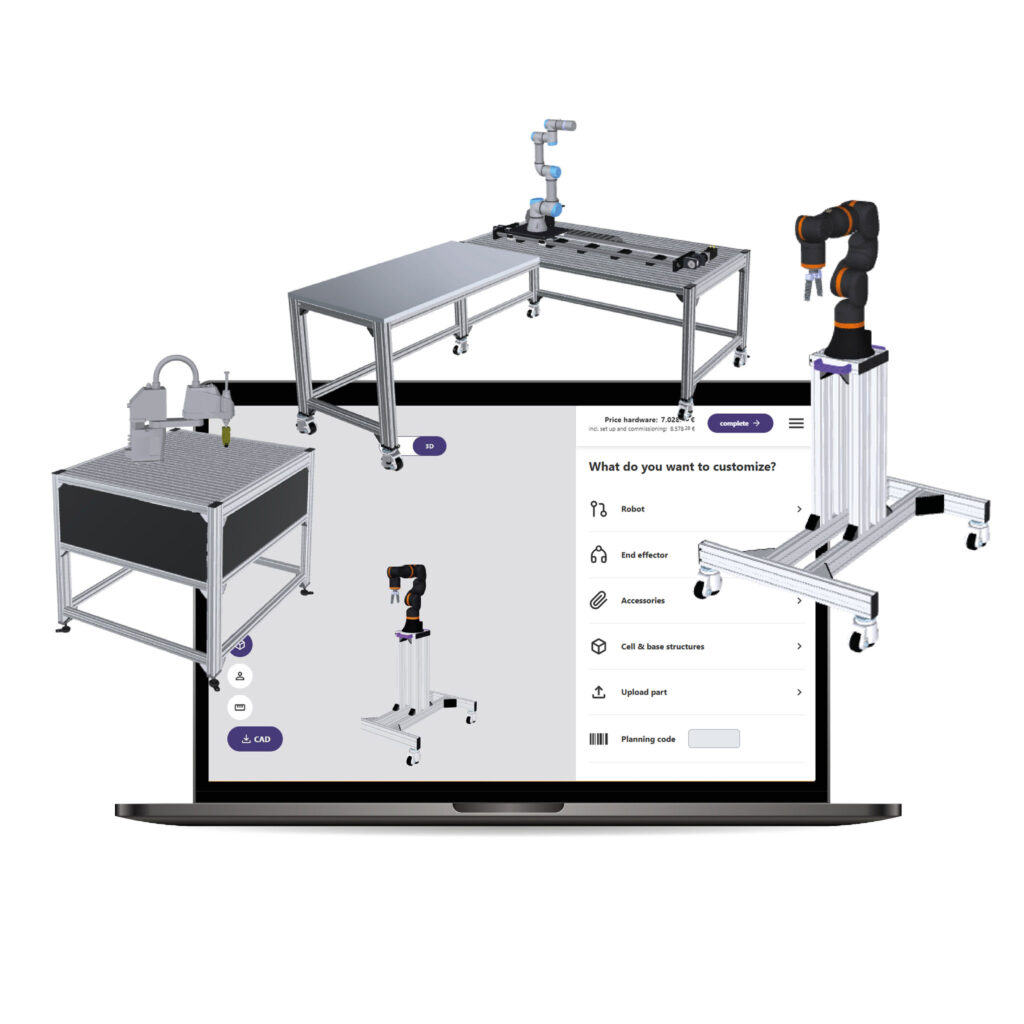
A carton-loading station shows how the work divides. Products arrive on a conveyor, and the gantry picks each one and places it in a fixed pocket inside the carton. Linear actuators define the working envelope, lead screws set gripper height and infeed guide position, and the motor controller runs the profile. When carton size changes, the screw-driven adjustments travel to a stored position instead of waiting on a wrench.
Maintenance-free motion means more uptime
Every lubrication point on a packaging machine is a recurring labor line. Industry research puts manual lubrication at roughly three minutes per grease point, on a machine averaging 20 of them. That is an hour a day, or 365 hours a year, for a single machine greased daily. At the BLS median wage for maintenance work in manufacturing, $30.94 an hour, those grease points run about $11,300 a year in labor.
Check the arithmetic against your own machine before quoting it. Greasing interval moves the result further than the wage rate does — the same 20 points on a weekly route cost a fraction of a daily one.
Grease carries a second cost in packaging specifically. It attracts airborne dust, sugar, and product fines, and it migrates toward places it does not belong. Self-lubricating iglide® nuts and drylin® bearings run dry, which closes that contamination path in washdown and food-contact zones.
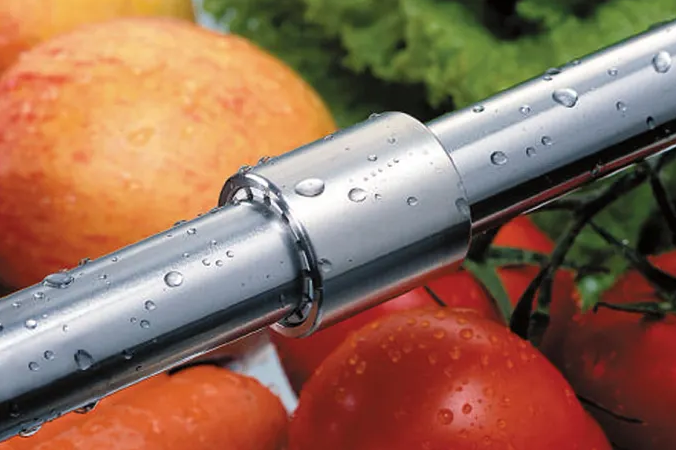
The failure numbers follow from that. One ball bearing manufacturer’s study attributes 54 percent of bearing failures to lubrication problems. A second study cited puts the share closer to 80 percent. A dry-running plain bearing cannot fail that way at all.
Packaging evidence backs the switch. A vertical form-fill-seal machine builder moved from metal linear ball bearings to drylin linear plain bearings after the metal bearings scored shafts and leaked grease onto the machines. The plain bearings have since passed 10 million cycles with little visible wear, on machines running up to 160 cycles per minute.
Read the full report: The True Cost of Bearing Lubrication
Precision motion is a maintenance decision too
Packaging lines run more formats in shorter batches than they did a decade ago, and the machines keeping up are the ones that reposition themselves accurately and then hold. Lead screws do that work in more places than a typical machine layout credits them for — infeed guides, camera mounts, gripper height, and the gantry actuators themselves.
Self-lubricating dryspin® screws and iglide® nuts add a second benefit on top of the positioning. They take lubrication tasks off the maintenance schedule and keep grease away from the product. Combined with drylin® actuators, motors, motor controllers, and RBTX robotic hardware, they give machine builders a path from a single automated adjustment to a complete cell. Every lubrication point designed out is a stop the line never has to take.
Closing thoughts
Placement accuracy in a packaging cell comes down to hardware that moves to a position and then holds it. Lead screws do that work at the infeed guide, the camera mount, the gripper height adjustment, and the gantry actuators themselves. Each one ties a commanded step to a fixed amount of travel. dryspin® thread geometry adds drive efficiency and service life on top of that, while self-lubricating iglide® nuts take the grease gun out of the maintenance schedule entirely. Precision and uptime stop competing. Paired with drylin® actuators, motors, motor controllers, and RBTX robotic hardware, lead screws carry a machine from one automated adjustment to a complete pick-and-place cell.