
Loading dock shore power: why the cable reel is the weak link
A truck backs into a dock door. The driver pulls a shore power cord from the reel on the dock wall and plugs it into the trailer. The interior lights stay off. The building supply is fine. The fault sits inside the reel, at the slip ring that carries current from the fixed wiring to the rotating drum.
Dock schedules leave little room for that kind of failure. Truck drivers already report detention, or waiting past their appointment time, at 39.3 percent of stops in 2023. A dead power connection adds one more delay at the moment the trailer, the dock crew, and the building all have to line up.
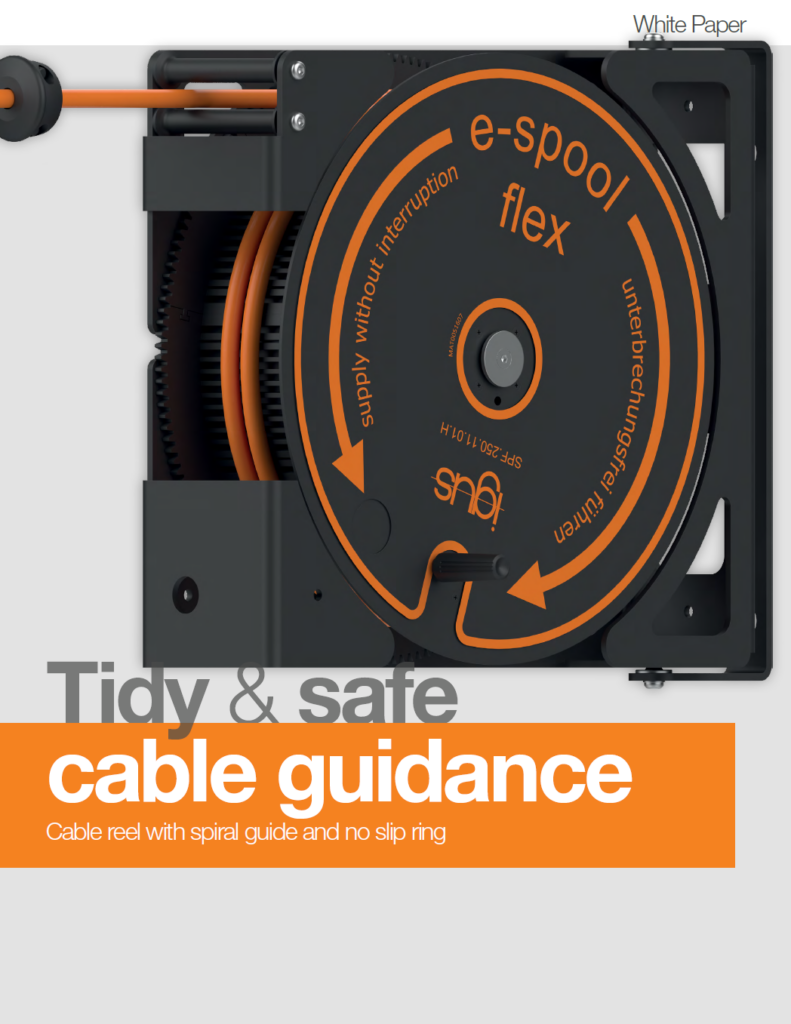
Taking the slip ring out removes that failure point. Read on for a look at why slip-ring reels break down at the dock and how the igus® e-spool® flex 2.0 replaces the slip ring with a spiral guide. You will also learn what to check when sizing a reel for a dock door.
What does shore power look like at a loading dock?
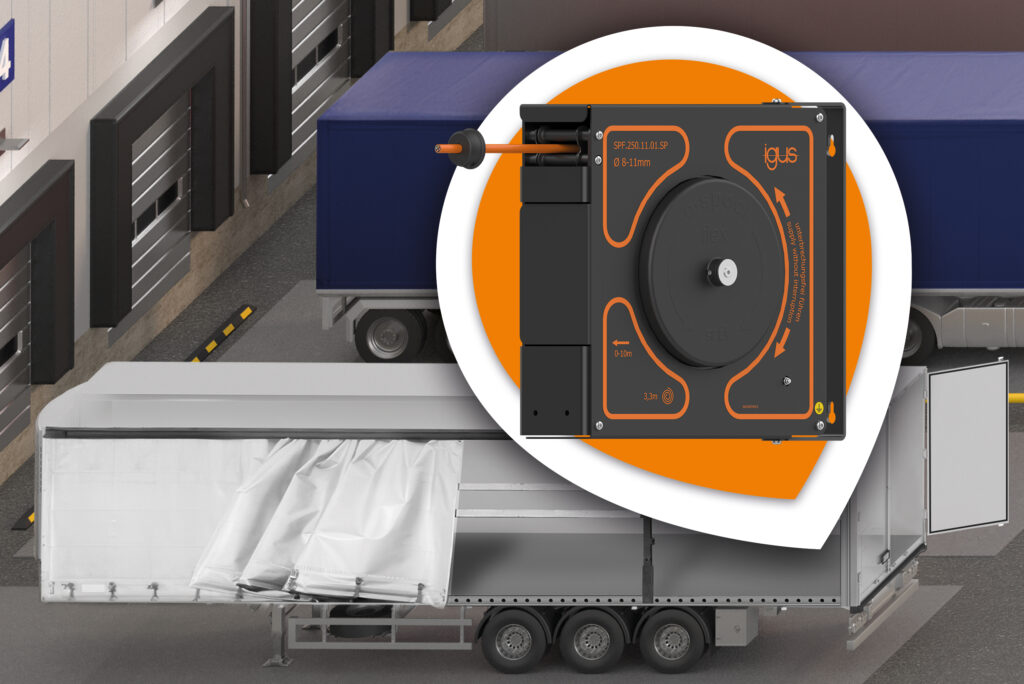
At a loading dock, shore power feeds a parked trailer’s electrical loads from a fixed building supply. In the dock setup igus® describes for the e-spool® flex, the reel mounts at the dock and its fixed end connects to the building’s power. The driver pulls the free end out to the trailer and plugs its connector into the trailer electronics, such as interior lighting, air conditioning, or ventilation.
The reel can also ride on the vehicle. Mounted on the trailer, its fixed end wires into the trailer electronics, and the driver pulls the free end out to the outlet at the dock. The cord then travels with the trailer instead of waiting at the door.
Which side to equip depends on what you control. A reel at every dock door serves each trailer that backs in, including visiting carriers, and stays under facility maintenance. A reel on each trailer travels with the fleet and works at any door with a live outlet.
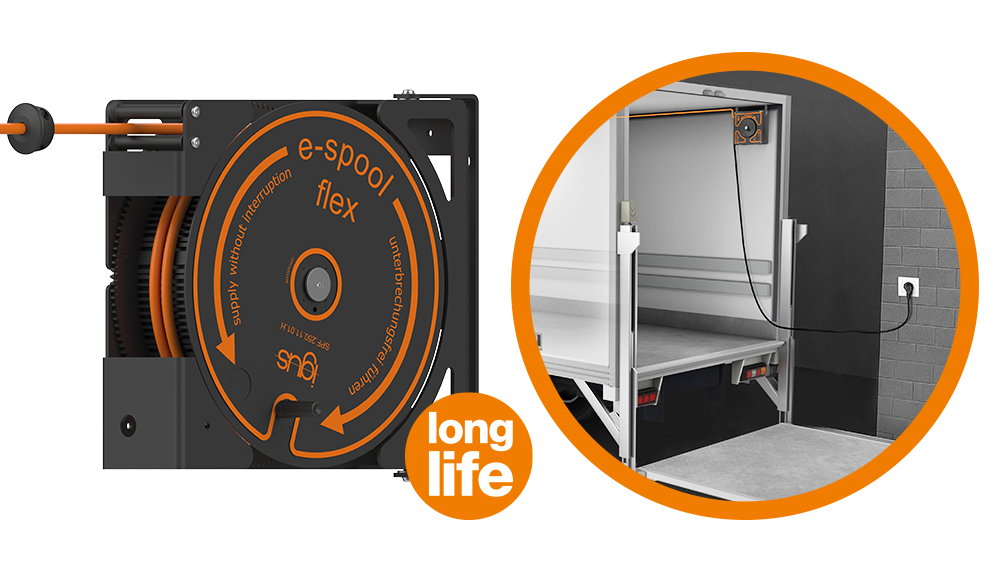
Either way, the building wiring stays fixed, and the trailer stays put once it is chocked, so all the motion lands on one short stretch of cable. The reel absorbs every pull, retraction, and snag along that stretch. That handling makes it the part most likely to decide whether the lights come on.
How does truck stop electrification compare with dock power?
Truck stop electrification brings the same idea to parked tractors. Drivers on federally required rest breaks plug in at an electrified parking space to run heating, air conditioning, and appliances without idling the engine. The U.S. Department of Energy describes the dual-system version, which pairs equipment on the truck with equipment at the stop, as shore power. The scale is large: Argonne National Library estimates rest-period idling burns more than 1 million gallons of fuel a year in the United States.
A truck stop connection supports a sleeper cab through a long rest period, while a dock connection supports trailer electronics through a loading cycle. Both depend on the cord. At either site, someone pulls a cable out, plugs it in, and stows it again, over and over, often outdoors. The hardware that carries power across that moving stretch sets the reliability of the whole connection.
Why do slip-ring cable reels fail at loading docks?
A conventional cable reel splits the circuit in two. A fixed cable runs from the supply to a slip ring at the hub, and a second cable winds onto the rotating drum. Brushes or sliding contacts ride on metal rings to carry current across that joint as the drum turns.
Dock doors expose the reel to moisture, dust, and temperature swings, and those conditions work on the contacts inside. Corrosion and mechanical wear gradually raise resistance at each contact until power flickers or drops out. A reel that sits idle between trailers also gives corrosion time to build on rings that regular rotation would otherwise wipe clean. That is why reel makers typically schedule periodic inspection and cleaning of slip rings and brushes.
Slip rings also limit what a reel can carry. Passing large amounts of data or media such as compressed air through a rotating joint is complicated. Many slip-ring drums ship as complete packages with their own cable, so a damaged cable can mean a replacement reel.
Without a reel, a cord left across the dock floor becomes a trip hazard for crews and a target for forklift and pallet jack wheels. Falls on the same level, the category that covers tripping over a loose cord, led to 405,540 U.S. work injuries involving days away, restricted duty, or job transfer across 2023 and 2024. A crushed cable jacket can take a dock door offline just as surely as a failed slip ring.
How does a spiral guide replace the slip ring?
The e-spool® flex 2.0 keeps one continuous cable from the dock wall to the trailer, with no split and no rotating contacts. A short section at the cable’s fixed end sits in the grooves of a spiral guide inside the reel. The rest of the cable winds onto the drum, and the reel sits in a housing that mounts in several positions.
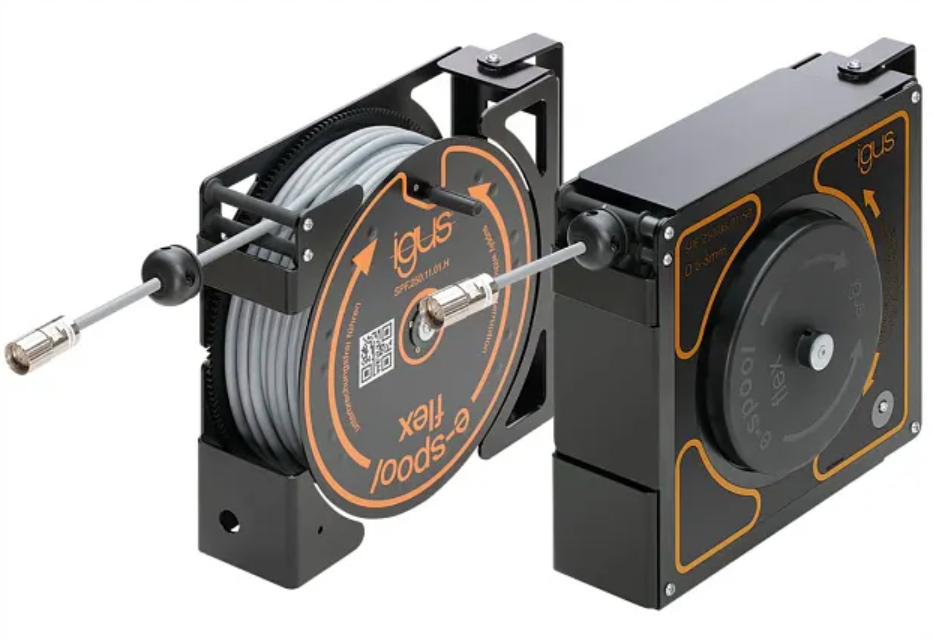
When the driver pulls the cable, the drum turns and the spiral section coils tighter or looser to take up the rotation. The fixed end never has to turn, so the cable does not twist and the connection to the building stays in place. On the way back in, a guided feed-through winds the cable evenly onto the drum.
With no sliding contacts in the electrical path, no contact surfaces are left to corrode. The same layout lets one reel carry power, data, and air without interruption. Bus cables and hoses for compressed air, vacuum, or liquids pass through the spiral guide the same way a power cable does.
What does a slip-ring-free reel change at the dock?
In igus® lab tests, the e-spool® flex held a steady pull-out force of about 10 newtons (2.2 pound-force) across its full extension. A slip-ring reel in the same test climbed unevenly to nearly double that. A light, even pull keeps tension on the cable constant from the first meter to the last.
Tests in the 5,500-square-meter (59,200-square-foot) igus lab in Cologne, Germany, put the e-spool flex at around 10,000 cycles. At two loading or unloading cycles a day, every day of the year, that works out to roughly 14 years of service. This durability quickly pays back the reel’s higher purchase price compared with a basic cable reel.
Mounting stays flexible on either side of the connection: a floor, wall, or ceiling at the dock, or the frame on a trailer. Cable coiled on a drum takes up less room than cord looped over a hook. With the cable stowed between trailers, the dock floor stays clear, and the cable avoids the kinks and knots that shorten its life.
How do you size an e-spool flex for a dock door?
The e-spool® flex 2.0 accepts cable diameters from 5 to 15 millimeters (0.2 to 0.59 inches) and extension lengths up to 15 meters (49.2 feet). Measure the path the cable has to cover. For a dock-mounted reel, that runs to the trailer connector at the farthest position a trailer will sit. For a trailer-mounted reel, it runs to the outlet, which varies with every site the fleet visits. Then choose a mounting spot that keeps the pulled cable out of forklift lanes.
Cable wound on a drum sheds heat less freely than cable in open air, so its current rating drops as layers build up. igus® points designers to the conversion factors for wound cables in DIN VDE 0298-4 when selecting a cable for the e-spool flex. Published extracts of that standard reduce the rating to 80% of the open-air value for a single wound layer, with steeper cuts for each added layer.
Three versions cover different ways of winding the cable back in:
- Version H: A manual reel with a hand crank. It is the simplest option and leaves retraction to the dock crew.
- Version SP: An automatic reel with a retaining spring and snap mechanism. The spring pulls the cable back, and the snap mechanism holds it at length while the trailer is connected.
- Version SB: The SP design plus a retraction brake that slows the cable on its way back to the reel.
Spring force is a trade-off: too little leaves cable lying on the dock floor between trailers, and too much lets it whip back toward the reel. A retraction brake splits the difference, which makes Version SB a strong fit where the pulled cable crosses a walkway.
The reel works with existing cables as well as new ones, and a damaged cable can be swapped out quickly. For new installations, chainflex® cables built for continuous motion are one option.
Keeping trailer power connected at the dock
A loading dock power connection is only as reliable as the reel between the wall and the trailer. Before specifying one, confirm three things: the cable runs continuously without a slip ring, it fits the reel’s diameter and extension limits, and its current rating accounts for winding. Get those three right, and the reel stops being the weak link at the dock door.