

Why polymer bearings are the preferred choice for medical and laboratory equipment
Medical and laboratory equipment places unique demands on motion components: it has to run quietly, reliably, and cleanly while meeting strict hygiene requirements. Traditional metal bearings need grease, scheduled maintenance, and corrosion protection. Polymer bearings offer an alternative, pairing self-lubricating materials with maintenance-free operation — a good fit wherever cleanliness, reliability, and uptime matter. This article explains why engineers keep specifying them, and how to approach material and design choices when you make the switch.
What makes medical and laboratory equipment different?
This equipment often runs around the clock in hospitals, labs, and pharmaceutical production, where a single failure or contamination event can disrupt workflows, delay results, or affect patient care. As a result, every component — bearings, linear guides, and complete motion systems — must meet a demanding set of expectations: cleanliness, continuous duty, repeated sterilization, limited maintenance windows, tight packaging, low noise, long life, and compatibility with sensitive electronics. Each of those traces back, at least in part, to one design decision: the bearing.
Why bearing selection matters
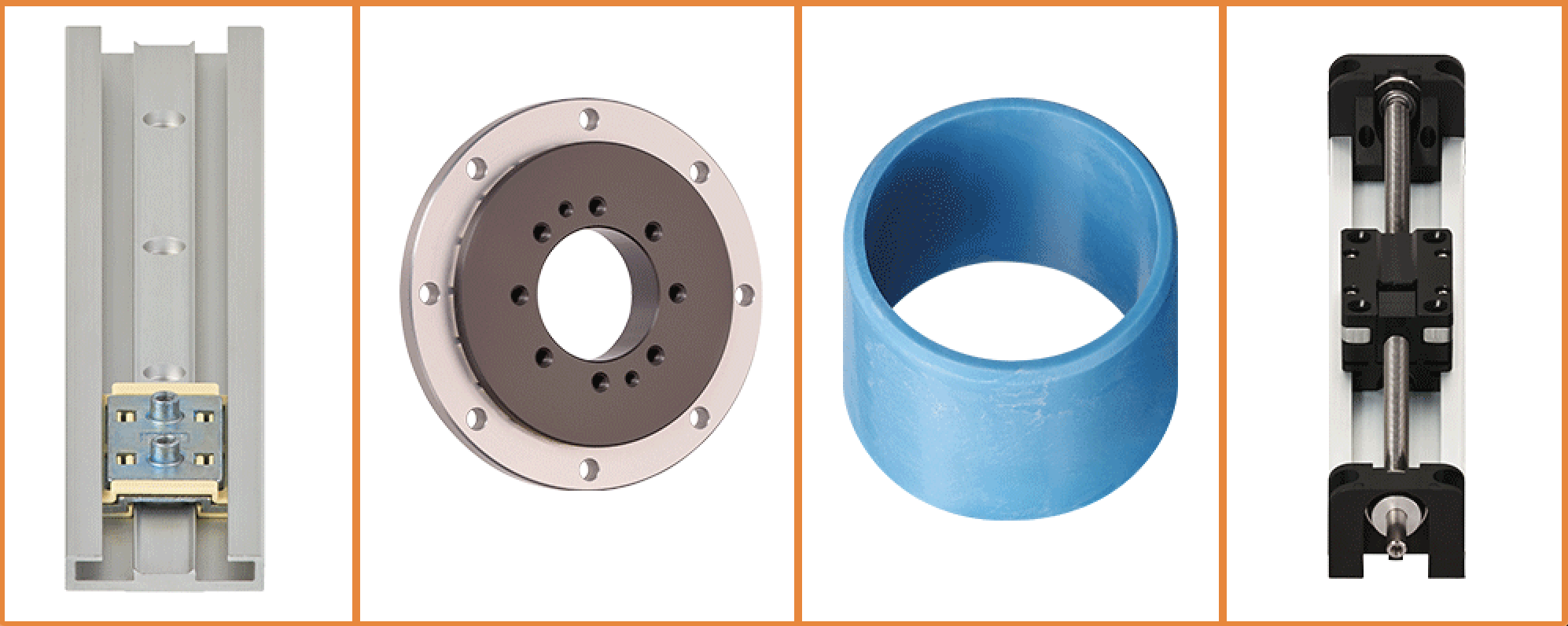
A bearing is often the smallest component in an assembly, yet it shapes maintenance, cleanliness, noise, durability, weight, corrosion resistance, and service life. Get it right and many problems never appear; get it wrong and they surface as service calls and downtime. That is why many engineers now replace lubricated metal bearings with self-lubricating polymer components such as iglide® plain bearings, drylin® linear bearings, and drylin N low-profile linear guides.
Maintenance-free bearings reduce service requirements
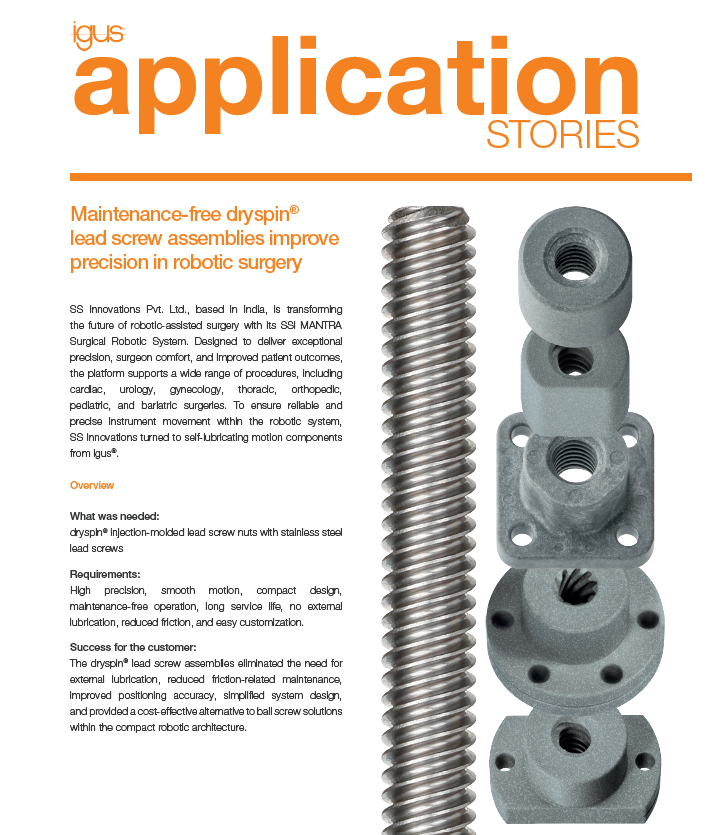
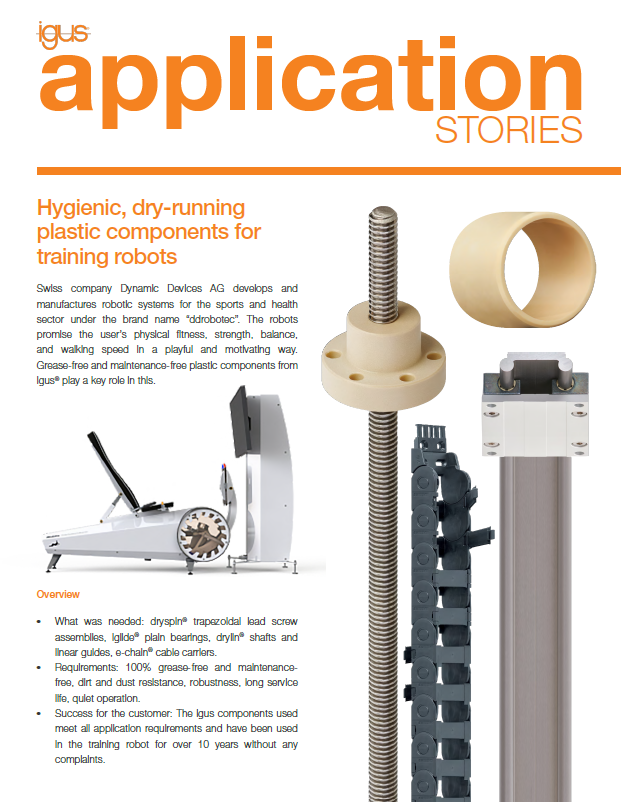
Self-lubricating iglide plain bearings carry solid lubricants throughout the bearing wall and release them during motion, so there is no grease fitting to service and no relubrication interval. That removes a real source of downtime: maintenance windows in hospitals and labs are limited, and taking an analyzer offline to relubricate disrupts operations. It also removes a common failure cause — over- or under-greasing by hand — and keeps performance consistent over the bearing's life. The same principle scales from a single pivot to a full axis built from drylin linear guides, actuators, and dryspin® lead screw systems.
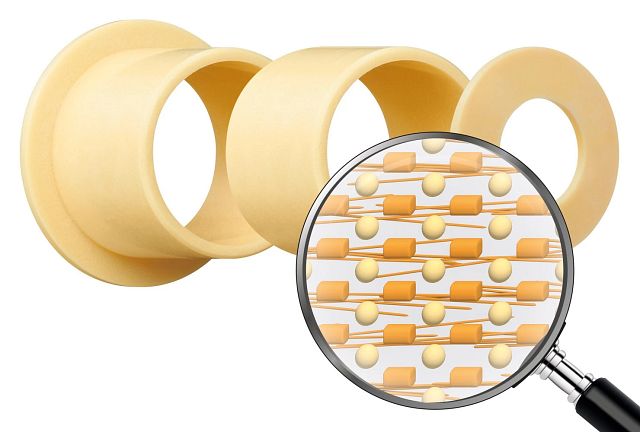
Self-lubricating materials help maintain clean operating conditions
Cleanliness is non-negotiable here. A greased bearing is a contamination risk every time it is serviced, and between services the lubricant can migrate and attract debris — reaching the sample in a diagnostic instrument or the patient in a bedside device. Self-lubricating polymers run dry, with no oils or grease film for particulates to collect on, so the interior stays cleaner over years of use. For product-contact points, FDA-compliant iglide materials such as iglide A181 meet regulatory requirements while keeping that dry-running behavior.
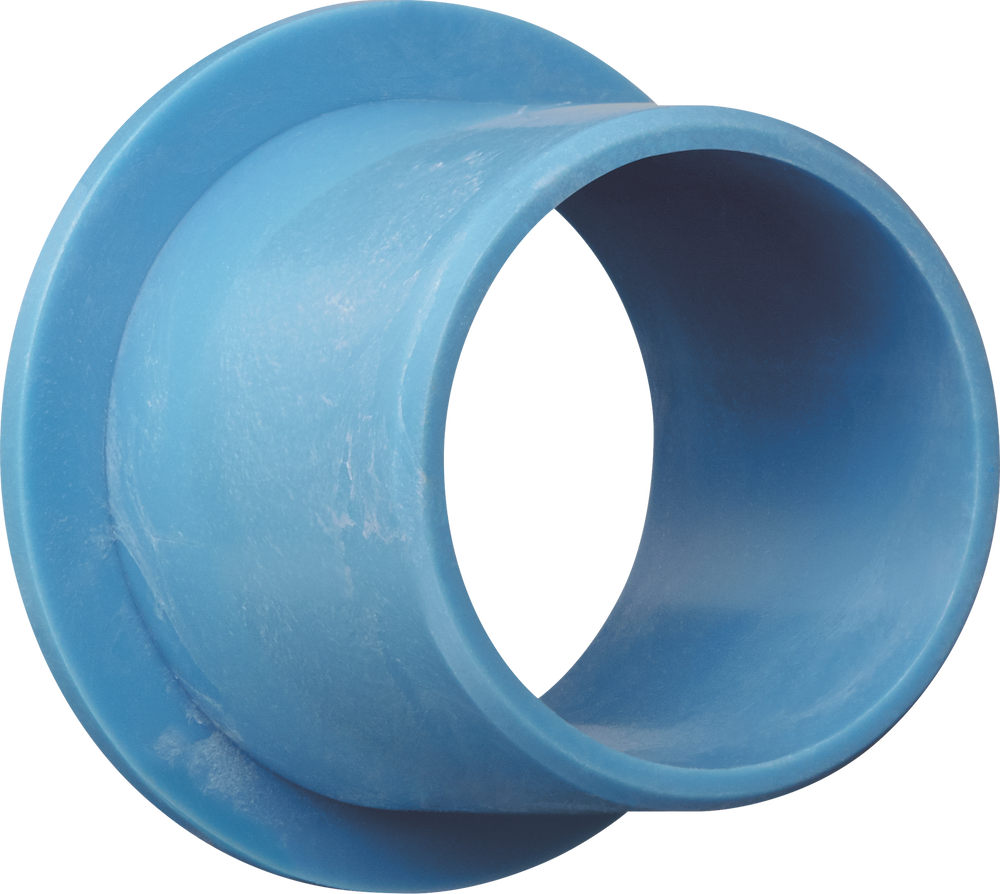
Lightweight components improve mechanical system performance
Polymer bearings and their aluminum rails are far lighter than steel equivalents, and that weight is dynamic. Less moving mass means lower actuator loads, smaller motors, faster acceleration, and better energy efficiency, and it eases the load on the surrounding frame. drylin N low-profile linear guides pair aluminum rails with polymer sliders, and miniature systems like the drylin SLN linear actuators bring this into small envelopes. For portable and battery-powered devices, lighter motion extends run time and simplifies handling.
Corrosion resistance supports long-term reliability
Medical equipment sees disinfectants, cleaning chemicals, and humidity constantly. Metal bearings rely on coatings and alloys that add cost and can still degrade; polymer bearings simply do not corrode, so performance stays predictable through years of repeated cleaning. Because iglide bearings and drylin linear systems are corrosion-free, they pair well with stainless or anodized shafting to resist the environment as a system. They are also non-magnetic, which is why polymer bearings — ball bearings especially — appear so often in imaging and MRI-compatible designs.
Quiet motion creates better working environments
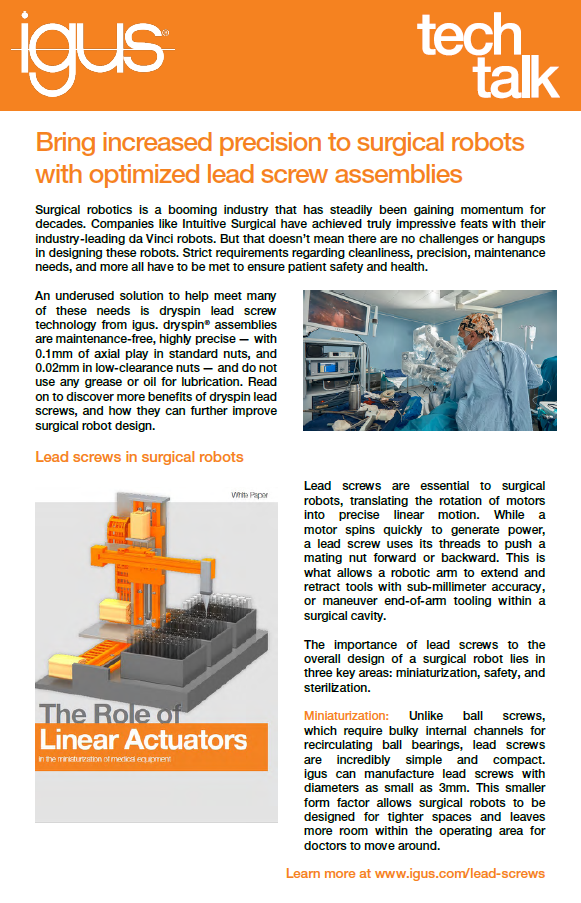
Noise is not just cosmetic in a ward, clinic, or shared lab — it affects patients and staff. drylin linear bearings and iglide plain bearings move by sliding rather than by recirculating rolling elements, which removes the ball-to-raceway contact noise and much of the vibration those systems generate. The smoother motion also protects measurement accuracy, so the quiet and the precision arrive together.
Compact bearing designs enable smaller equipment
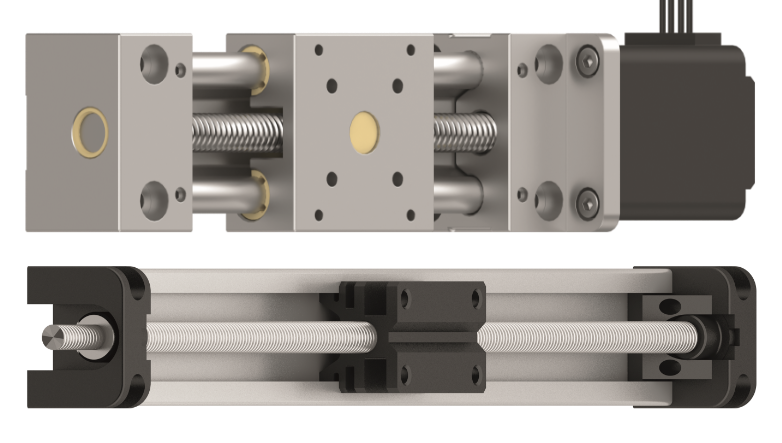
Nearly every medical device is shrinking, and space is usually the binding constraint. Compact polymer components ease it: drylin N miniature linear guides and drylin SLN linear actuators fit guided motion into envelopes measured in tens of millimeters, and the iglide PRT-04 slewing ring adds self-lubricating rotary support where a conventional bearing will not fit. Specifying these early leaves more room for the electronics and fluidics that define the product.
Polymer bearings support reliable motion over millions of cycles
Analyzers and automated systems can run for years, so their bearings must hold up over millions of cycles. The useful metric is not just long life but predictable wear, so a device can be designed around a known service interval instead of an unexpected failure. Engineered iglide materials deliver low, predictable wear and consistent friction across a design life of a decade or more, and drylin linear bearings apply the same tested materials to linear motion. That predictability is backed by testing: igus® validates materials under realistic loads and speeds and feeds the data into various online configurators that can predict service life based on application parameters.
Selecting the right polymer bearing material
No single polymer suits every application. Working through a few parameters narrows the range quickly.
Load requirements
Separate static load (at rest) from dynamic load (in motion). iglide® grades trade maximum surface pressure against friction and wear, so both figures — plus any edge loading — point you toward the right family.
Speed
Sliding velocity and duty cycle set how much frictional heat the bearing generates. A continuous-duty analyzer stresses a material differently than an intermittent mechanism, even at the same load.
Temperature
Account for both the temperature range and thermal expansion, since polymers expand more than metals and sterilization can cause short thermal spikes. Set bearing clearance with that in mind.
Chemical exposure
Cleaning agents and reagents vary widely, so match the material's chemical resistance to the specific media it will meet rather than to a generic “chemical-resistant” label.
Shaft material compatibility
Polymer bearings run against steel, aluminum, carbon fiber, and even plastic, though the pairing affects wear. They tolerate softer shafts than ball bearings do, which can widen your options and lower cost. To speed selection, igus offers an iglide material selection guide, an online product finder, and a service life calculator.
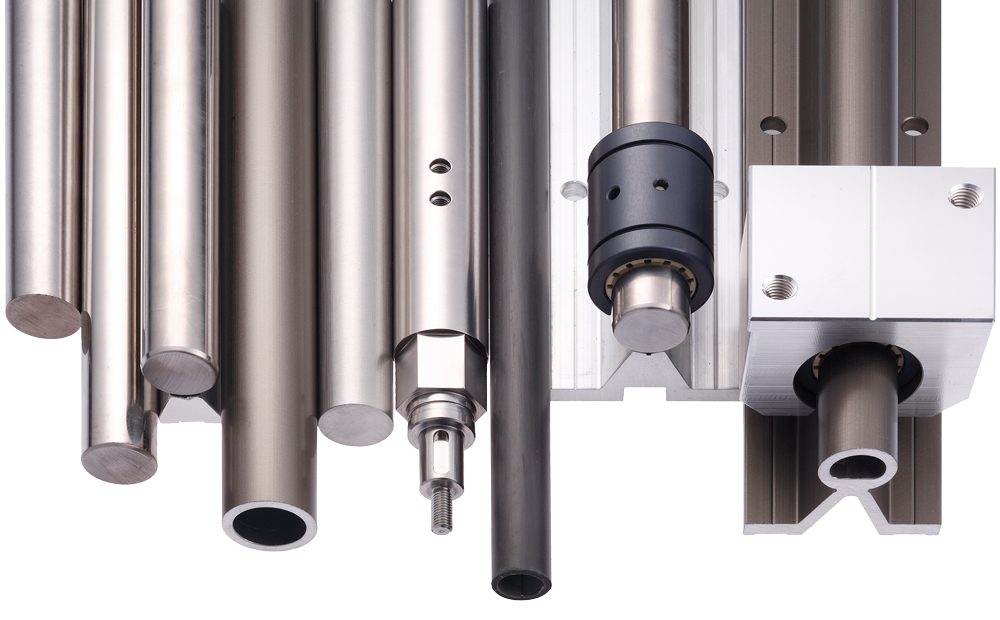
Design considerations when replacing metal bearings
Retrofits are usually straightforward with a few checks. Set clearance deliberately, since polymers expand more than metals. Confirm shaft finish and hardness — polymer tolerates rougher shafts, but very rough surfaces still wear faster. Check housing tolerances for press fits.
Design to the material's strengths: engineered composites carry high surface pressures and edge loads that commodity plastics cannot, and because a self-lubricating bearing has no lubricant film to break down and no layered liner, the full wall thickness is available to wear — giving a long service life you can calculate before you commit.
Applications that benefit from polymer bearings
Polymer bearings shine wherever cleanliness, quiet operation, corrosion resistance, or maintenance-free duty drive the design.
- Laboratory automation: Sample handling and dispensing run continuously and cannot tolerate lubricant near the chemistry; drylin linear actuators and dryspin lead screws provide dry actuation.
- Diagnostic equipment: Analyzers need quiet, hygienic, repeatable motion, where iglide plain bearings support pivots without lubrication.
- Precision positioning: Stages that must return to the same spot benefit from the consistent friction of drylin linear guides.
- Rotary adjustment: Where a head or table swivels, iglide PRT slewing rings give compact, self-lubricating support.
- Compact automation: For pick-and-place inside benchtop instruments, drylin gantry robots combine these components into a multi-axis system.
Engineers rarely specify one bearing in isolation; more often they combine these into a complete maintenance-free motion system, so the benefits apply to the whole machine rather than a single pivot.
How polymer bearings help reduce total cost of ownership
Purchase price is the least of it. The savings accrue over the equipment's life: no lubrication labor, fewer wear-related replacements, and less downtime. Assembly is faster with no greasing step, and lighter mass can cut energy use. For an OEM, longer service intervals make the product easier to support; for the operator, they mean higher uptime and fewer budget surprises. Over the full lifecycle, maintenance-free polymer systems shift the economics in the owner's favor.
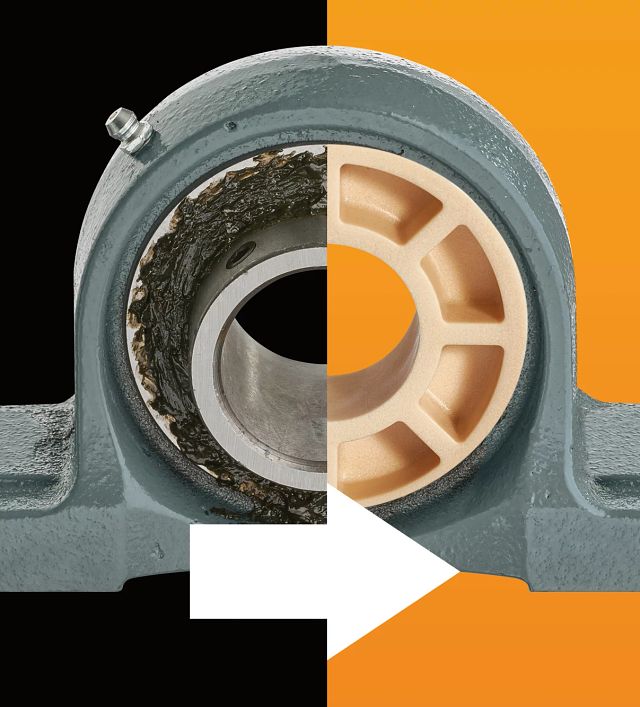
Why engineers continue to replace traditional metal bearings
The case rests on a consistent set of advantages: maintenance-free operation, long and predictable life, reliability over millions of cycles, light weight, corrosion resistance, quiet motion, compact designs, and lower lifecycle cost — with the flexibility to combine them into complete systems. None of it is incidental; each benefit traces back to the bearing as a deliberate design choice rather than an afterthought.
Conclusion: designing reliable motion systems for medical equipment
The right motion components determine how clean, quiet, and dependable the finished equipment will be. Self-lubricating polymer bearings meet the requirements that define this field: dry, hygienic operation; corrosion resistance; light, compact construction; quiet motion; long life; and lower cost of ownership. With a portfolio spanning iglide bearings, drylin guides and actuators, dryspin lead screws, and iglide PRT slewing rings, igus offers a complete ecosystem of maintenance-free motion solutions engineered to work together.