
Underwater motor requirements: IP ratings, seals, and materials
On this page
What to look for in an underwater motor
The robotics industry is constantly expanding, and with it new areas of application are arising. Robots now clean ship hulls, inspect offshore pipelines, and even weld underwater — jobs that once meant sending a diver over the side, but are now part of a $5.2 billion sub-industry. Each of those machines needs an underwater motor that keeps turning while water presses against every seal, shaft, and cable entry.
Most electric motors are not built for that job. A general-purpose motor may be able to handle a rinse or a rainstorm. Below the surface, though, water works past the shaft and cable entries and into the windings, causing short circuits and corrosion that end the motor’s service life.
This guide explains how to read an IP68 rating, which seals and materials hold up to depth and saltwater, and where the encoder, cables, and motor controller belong.

Understanding IP ratings for underwater motors
An Ingress Protection (IP) rating, defined in the international standard IEC 60529, describes how well an enclosure keeps out solids and water. The letters “IP” are followed by two digits, and each digit is graded on its own scale.
The first digit covers solid objects and dust, from 0 (no protection) to 6. A 5 means some dust can get in, but not enough to interfere with operation, while a 6 means the housing is fully dust-tight.
The second digit covers water, from 0 to 8. Levels 1 through 4 deal with dripping and splashing, 5 and 6 cover water jets from a nozzle, and only 7 and 8 test an enclosure fully underwater. For an underwater electric motor, the second digit decides whether the motor survives the job.
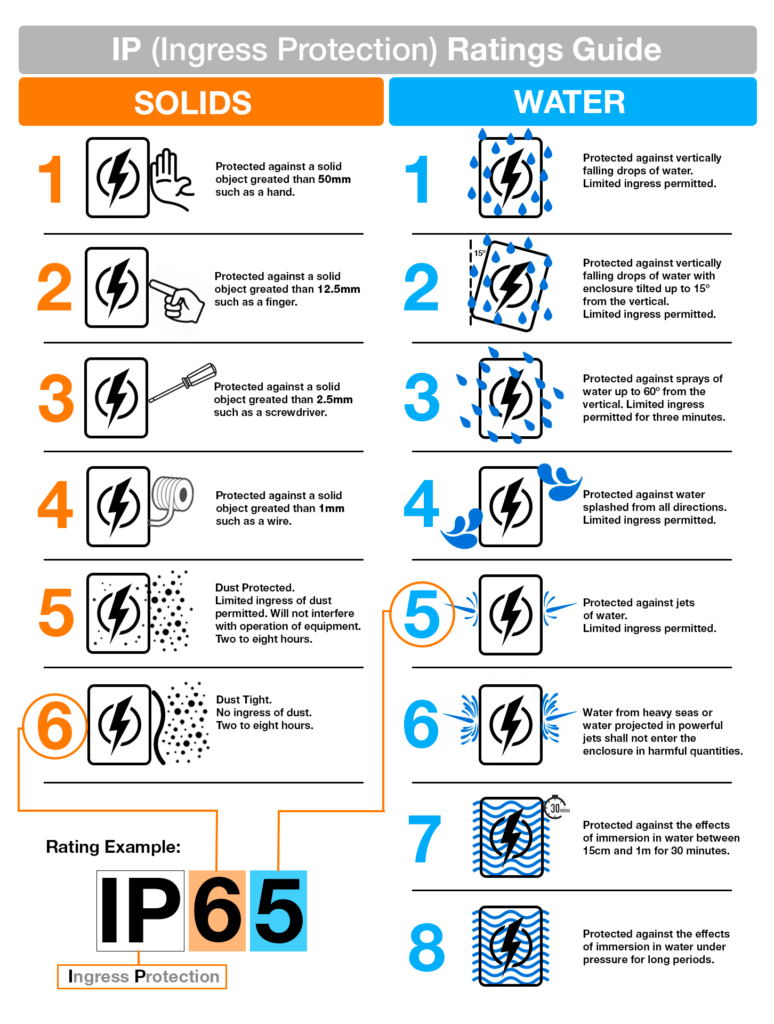
IP ratings for water resistance and submersion
| IP rating | Protection |
|---|---|
| IP44 | Protection against splashing water and objects greater than 1 mm (0.04 in) |
| IP54 | Protection against splashing water and limited dust ingress |
| IP65 | Dust-tight and protection against water jets |
| IP67 | Dust-tight and protection against temporary immersion |
| IP68 | Dust-tight and protection against continuous immersion under specified conditions |
IP67 comes with a defined test: the enclosure sits underwater for 30 minutes, with its lowest point 1 m (3.3 ft) below the surface. IP68 has no fixed depth or duration in the standard. It only has to be more severe than the IP67 test, and the manufacturer sets the actual depth and time limits. Two motors can both carry an IP68 rating and still be rated for very different conditions, so always read the depth and duration on the datasheet.
What makes a motor suitable for underwater use?
Waterproof motor housing
The housing is the first barrier between the water and the motor’s windings, magnets, and bearings. Underwater motors use fully sealed enclosures with gasketed end caps and no vent openings, because under pressure, any gap or pore in the housing becomes a path for water.
Ratings below IP67 are not tested for immersion, even on motors built for harsh environments. igus® drylin® E stepper motors, for example, come in IP40, IP52, and IP65 versions for applications ranging from dry indoor machines to washdown areas, but only the IP68 version is built to run underwater.
Sealing every joint to tighter tolerances makes these housings cost more, but that cost is small next to the price of pulling a failed motor off a hull.
Sealed shafts and electrical connections
A sealed housing still has to let a shaft out and power in. The output shaft is the most common leak path: it rotates, so the seal around it wears, and any wear opens a channel straight to the front bearing. In a true underwater motor, the shaft seal is part of what earns the IP68 rating, not an accessory added afterward.
Cable entries are the second weak point. A cable gland, potted lead, or sealed terminal box has to hold the same rating as the housing, and so does the cable jacket. An IP68 motor wired to an unsealed connector, or to a cable that wicks water along its conductors, no longer behaves like an IP68 system.

A gearbox mounted to the motor needs its own seals, rated for the same depth. Encoders and brakes avoid that weak point when they are built into the sealed motor housing instead of mounted outside it. The motor controller should sit topside or inside a sealed enclosure.
Corrosion-resistant materials
Water attacks metal even when it never reaches the windings. Freshwater slowly oxidizes unprotected steel, while the chlorides in saltwater speed up pitting and crevice corrosion on shafts, fasteners, and housings.
Stainless steel is the usual answer, but the grade matters. 304 stainless steel works well in freshwater and splash zones. 316 stainless steel adds molybdenum, which improves pitting resistance in chloride-rich seawater and makes it the better default for saltwater installations.
Mixing metals adds another risk. When dissimilar metals touch in saltwater, galvanic corrosion eats away the less noble one, so check every bracket and fastener against the housing material.
Operating depth and water pressure
Water pressure rises steadily with depth: every 10 m (33 ft) of seawater adds about one atmosphere, or roughly 1 bar (14.5 psi). At 10 m, a motor’s seals are holding back a load of water pressure they never see on a factory floor.
That pressure pushes water harder against every seal lip, gasket, and cable entry. A motor that stays dry at 1 m may leak at 5 m if its seals were only tested to IP67 conditions. Check the rated immersion depth, then build in margin for waves and currents.
How to choose the right underwater motor
Confirm each of these specifications before ordering:
- IP rating: IP67 for brief, occasional immersion; IP68 for continuous submersion.
- Maximum operating depth: rated depth and duration, with margin beyond your deepest point.
- Freshwater or saltwater: water chemistry decides housing, shaft, and fastener materials.
- Torque and speed: at the load, including drag from moving through water.
- Operating temperature: water temperature plus the motor’s own heat, since a sealed housing cannot vent.
- Installation space and mounting: flange size, shaft length, and room for sealed cable routing.
- System compatibility: actuator, gearbox, cable, and motor controller rated for the same conditions.
IP68-rated stepper motors for underwater applications
The igus® drylin® E NEMA23 stepper motor is built for submerged use. Its housing carries an IP68 rating for depths up to 10 m (33 ft), or about 1 bar (14.5 psi). As a two-phase hybrid stepper motor, it runs open loop without an encoder, which keeps wiring simple. Open-loop steppers can lose steps under overload, though, so the integrated-encoder version adds closed-loop feedback that confirms the motor’s actual position.
Standard igus cables for the motor run up to 20 m (66 ft), long enough to keep the motor controller out of the water. Longer runs are possible, but voltage drops along the extra length and lowers the motor’s speed, so they call for custom cable assemblies with a larger conductor cross-section.
| Specification | drylin® E IP68 stepper motor |
|---|---|
| Installation size | NEMA23, 56 mm (2.2 in) flange |
| Protection class | IP68, up to 10 m (33 ft) |
| Holding torque | 1.3 Nm (11.5 lb-in) |
| Nominal current | 4.2 A |
| Motor connection | Terminal box |
| Encoder option | Integrated encoder, M12 connector |
Typical uses include underwater inspection rigs, test tanks, and camera or sensor positioning.
Complete underwater motion solutions with igus®
A waterproof motor solves only part of the problem. The actuator, bearings, shafts, and rails sit in the same water, and any one of them can stop the machine. Greased ball bearings are a common weak point: water washes the lubricant out and into the surroundings.
drylin® linear actuators use self-lubricating polymer plain bearings, so there is no grease to wash away. Stainless steel drylin W linear guides and iglide plain bearings on 304 or 316 stainless steel shafting complete the system. When every moving part is specified for the same water conditions as the IP68 motor, no single part becomes the weak link.
Further reading: 5 key considerations for designing underwater linear systems
Application example: underwater hull-treatment robot
Remotion builds robots that treat ship hulls below the waterline. Its engineers first considered greased ball bearings, but leaching grease would have polluted the water the robot works in. Switching to drylin linear bearings gave the robot corrosion resistance, lower maintenance costs, and no grease in the water.
Finding the right motor for your underwater application
An underwater motor has to keep water out at every entry point, not just the housing. Start with the second digit of the IP rating, confirm the manufacturer’s IP68 depth and duration limits, and check that shaft seals and cables carry the same protection. Then hold the rest of the motion system to the same standard, because a sealed motor on a corroding actuator still ends in a service call.