


Is your facility ready for automated material handling? Here’s how to tell
Material handling quietly eats a large share of the working day on most production floors. Order picking alone accounts for about 55% of warehouse operating costs. Operators load and unload machines, pickers stage parts, and forklifts shuttle pallets between operations — work that keeps production moving but rarely gets the engineering attention the machines themselves receive.
As order volumes climb and skilled workers get harder to hire, these repetitive movements often become the real limit on throughput. The hard part is not recognizing that automation could help. It is deciding which tasks are worth automating, what type of robot fits each one, and whether the payback justifies the spend.
At its core, automated material handling uses robot arms, mobile robots, and grippers to move, load, unload, and position parts across a facility with little manual effort.
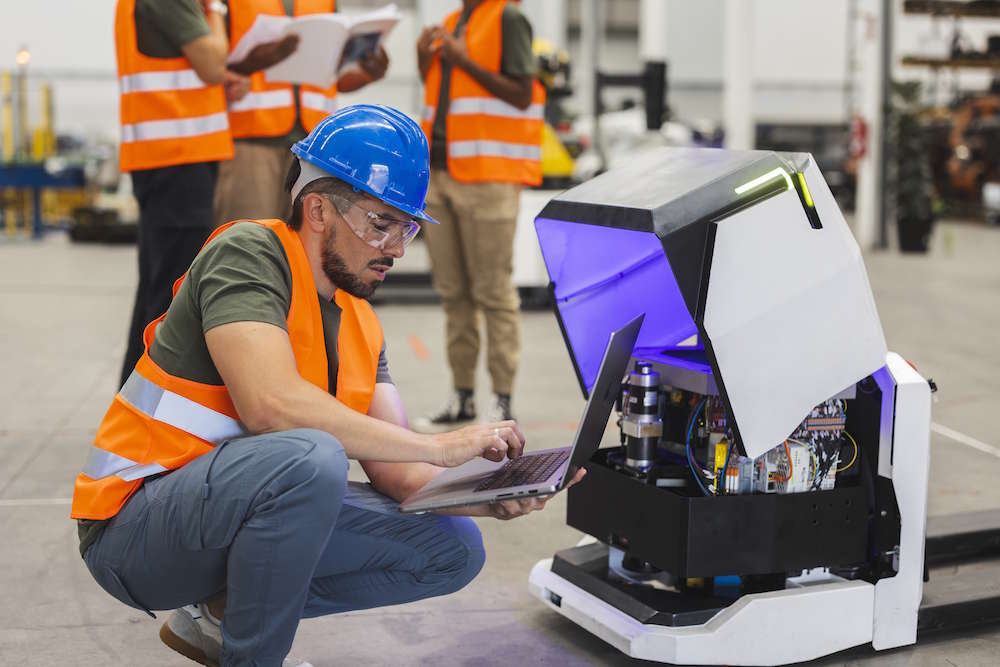
You do not need to automate a whole production line to see a return. Many plants gain measurable ground by automating one repetitive task — a single machine-tending cell or transport route — that clears a bottleneck or frees people for higher-value work.
This guide lays out a practical way to spot those opportunities, shows where they tend to hide on the floor, and matches each one to the type of automation best suited to it.
How to identify your best automation opportunity
Not every material handling task is worth automating. The strongest candidates share a few traits that make the build simpler and the return easier to prove. Before you look at any specific robot, judge the task itself against the criteria below.
Start with repeatability
Repeatability is the first thing to check. The more consistently a task runs, the easier it is to automate reliably. A standardized motion — the same pick, the same placement, every cycle — needs less custom engineering, simpler programming, and fewer add-ons like vision or sensors to hit a consistent result.
Ask yourself:
- Do operators perform the same task over and over?
- Does the part follow the same path every cycle?
- Are parts presented in a predictable position and orientation?
- Is the surrounding environment stable, without frequent changes?
If most answers are yes, you have found a task that likely suits automation.
Evaluate volume and variability
Once a task looks repeatable, weigh its volume and variability. High-volume, repeatable work usually makes the strongest case, because even a small saving per cycle adds up fast across a shift.
Common examples include:
- Machine loading and unloading
- Conveyor transfers
- End-of-line palletizing
- Repeated material transport routes
- Part sorting and staging
Tasks with frequent product changeovers, inconsistent part presentation, or shifting workflows are a different story. They often need extra technology — machine vision, flexible grippers, or a more capable robot — to cope. High variability does not rule automation out. It simply raises the complexity of the solution.
Look beyond labor hours
Many plants judge an automation project on direct labor savings alone. Labor matters, but the highest-value projects usually pay off in several places at once.
Add up the full cost of the current task, including:
- Labor hours
- Machine idle time
- Overtime
- Forklift use
- Work-in-process inventory
- Production bottlenecks
- Ergonomic strain
- Safety incidents
- Missed throughput
A task run by a single operator can still be a strong candidate if it starves a machine of work or chokes a downstream operation.
This is one of the main ways automated material handling systems reduce operating costs. Instead of simply swapping out labor, they smooth production flow, clear bottlenecks, and get more out of the machines you already own.
Prioritize the best opportunities
The strongest projects tend to combine:
- High repeatability
- High production volume
- Low process variability
- A measurable effect on throughput, labor, or safety
If a task checks most of these boxes, it is worth a closer look. The next move is not picking a robot. It is working out which type of automated material handling solution fits the job.
Common automated material handling applications
By now you should know what makes a task a strong candidate. The next step is spotting where those tasks tend to sit on the floor.
Every facility differs, but a handful of applications show up again and again as the most common — and most successful — automation projects. Each pairs a repeatable process with a clear, measurable cost: idle machine time, lifting strain, or forklift miles across the plant.
Machine tending
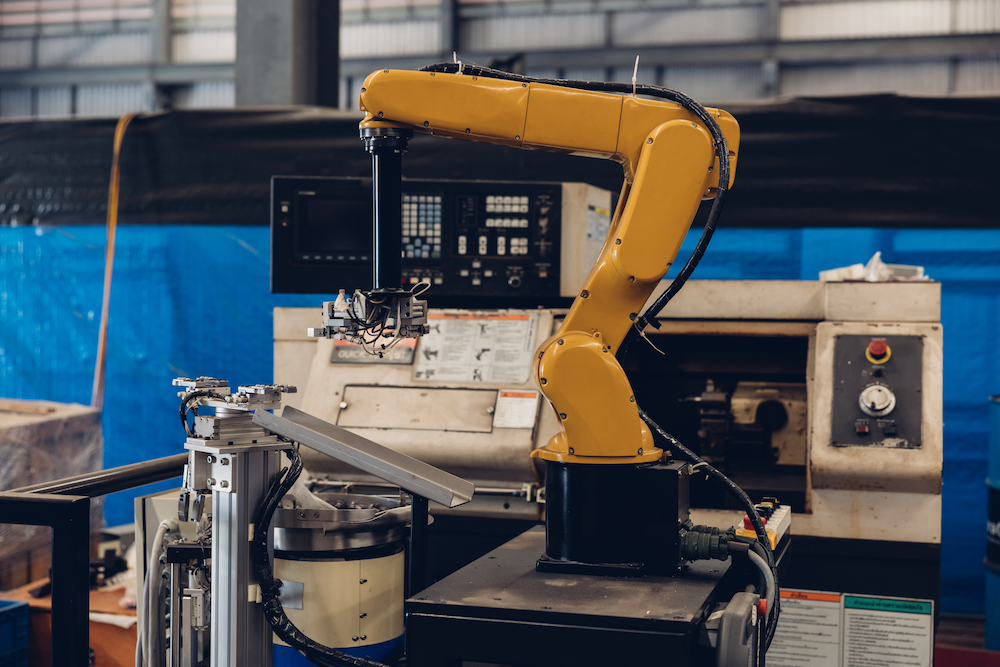
Machine tending is one of the most common entry points into industrial automation, because it targets a familiar source of lost output: operator waiting time.
On many machining, molding, and stamping lines, an operator spends a few seconds loading or unloading a machine, then stands by while the cycle runs. The idle time adds up: CNC machines average just 20–30% utilization, so they sit unused far more often than they cut. Hand that repetitive load-and-unload to a robot, and the operator is free to inspect parts, run setups, and check quality — the work that needs a person.
What to look for:
- Consistent part presentation
- Predictable machine cycle times
- Long stretches of operator waiting
- Machines that sit idle between cycles
Typical solutions: Collaborative robots for lighter payloads and slower cycle rates; industrial robot arms for higher throughput or heavier parts.
Bin picking
Not every application starts with parts laid out in neat rows.
Plenty of plants receive parts loose in bins, totes, or containers, where orientation shifts from one piece to the next. That randomness used to make automation hard. Machine vision has changed the math: a guided robot can now find and pick a randomly placed part with 0.02mm repeatability.
Bin picking earns its place when people burn time searching for, orienting, or staging parts before a line can even start.
What to look for:
- Randomly oriented parts
- Operators sorting parts by hand
- Time lost locating individual pieces
- High-volume pick-and-place work
Typical solutions: Vision-guided robotic systems using 2D or 3D machine vision.
End-of-line palletizing
Palletizing is one of the most proven material handling applications, because the work is repetitive, physically hard, and tied straight to output.
A robot palletizer stacks the same box the same way every time. That steadies pallet quality and keeps the line running without someone stacking finished product by hand. It also spares workers a real injury risk: of the 240,000 workplace musculoskeletal injuries recorded in 2020, more than a third happened while people were moving material.
What to look for:
- Product piling up at the end of the line
- Frequent manual lifting
- Overtime just to keep pace with output
- Inconsistent pallet quality
Typical solutions: Cobot palletizers, industrial robots, or gantry systems, depending on payload, throughput, and pallet pattern.
Dive Deeper: RBTX palletizing configuration guide
Material transport and intralogistics
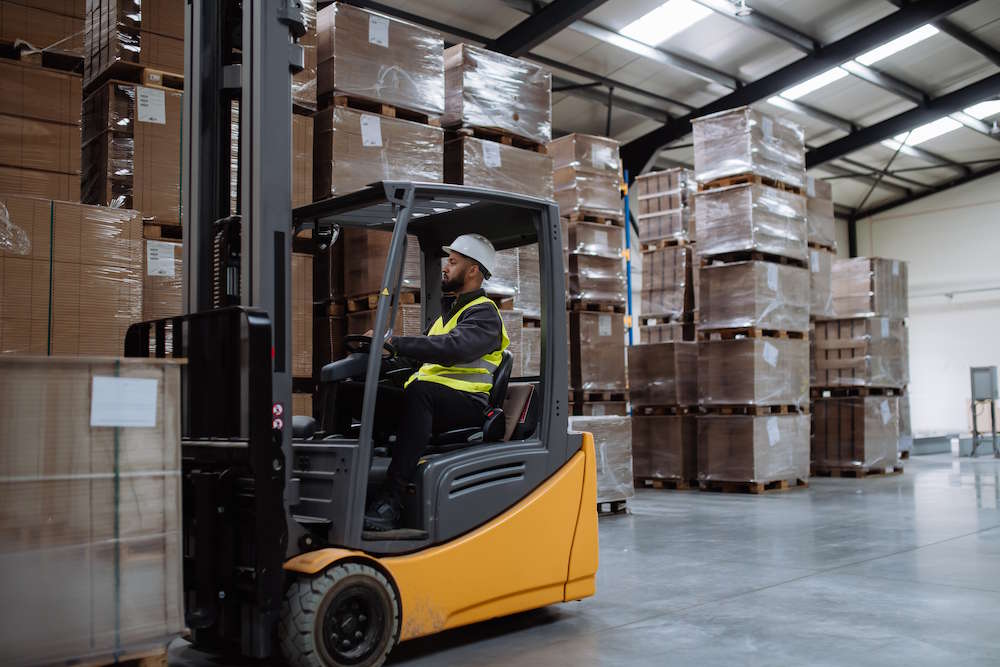
Moving material rarely adds value to the part itself, yet it eats as much as 90% of product flow time in job shops.
Whether workers wheel raw stock to a line, carry work-in-process between stations, or make repeated forklift trips, these routine trips are often ripe for automation. Move that internal transport onto a robot, and people spend more time supporting production and less time walking the floor.
What to look for:
- Repeated transport routes
- Heavy forklift traffic
- Operators carrying parts between workstations
- Labor spent mostly moving product rather than processing it
Typical solutions: Autonomous mobile robots (AMRs) for dynamic routes, or automated guided vehicles (AGVs) for fixed paths.
Matching the solution to the problem
Once you have singled out a task worth automating, picking the technology gets much simpler. Often the application itself points to the answer.
The table below is a starting point, not a final spec. The real choice always comes down to payload, cycle time, floor space, part presentation, and production volume.
| If you are trying to... | A good place to start is... |
|---|---|
| Move materials between workstations | Autonomous mobile robots (AMRs) for dynamic routes, or automated guided vehicles (AGVs) for fixed, repeatable paths. |
| Load and unload machines | Collaborative robots (cobots) for lighter payloads (generally under 20 kg) and slower cycles. Industrial robot arms suit heavier parts, faster cycles, or high-volume runs. |
| Pick randomly oriented parts | Vision-guided robotic systems that use 2D or 3D machine vision to locate parts before picking. |
| Palletize finished products | Palletizing systems — cobot palletizers, industrial robots, or gantry systems — chosen by payload, throughput, and pallet pattern. |
Why automated material handling projects succeed — or fail
Spotting a strong opportunity is only step one. Whether a project succeeds rests as much on understanding the process as on choosing the right robot. Many projects turn out harder than planned — not because of the robot, but because a few process questions were skipped early. Work through these before you compare any equipment.
What is the current process costing?
Before you can size the return on an automation project, you need the cost of the task as it runs today. Look past direct labor and count:
- Labor cost
- Machine downtime
- Overtime
- Production bottlenecks
- Quality problems
- Safety risk
- Lost throughput
That total becomes the benchmark every proposed solution is measured against.
Can the whole system work together?
Automation is far more than a robot. Grippers, vision systems, controllers, safety scanners, conveyors, and software all have to work as one system. Before you weigh any equipment, find out whether those parts have already been proven to run together, or whether you are signing up for extra integration and engineering.
What will implementation require?
Not every project asks for the same engineering effort. Some cobot and palletizing cells are built for fairly quick deployment. Others — vision-guided bin picking, custom machine tending, or an AGV fleet — call for programming, integration, and process work. Knowing which one you are facing early sets honest expectations for cost, timeline, and the internal people you will need.
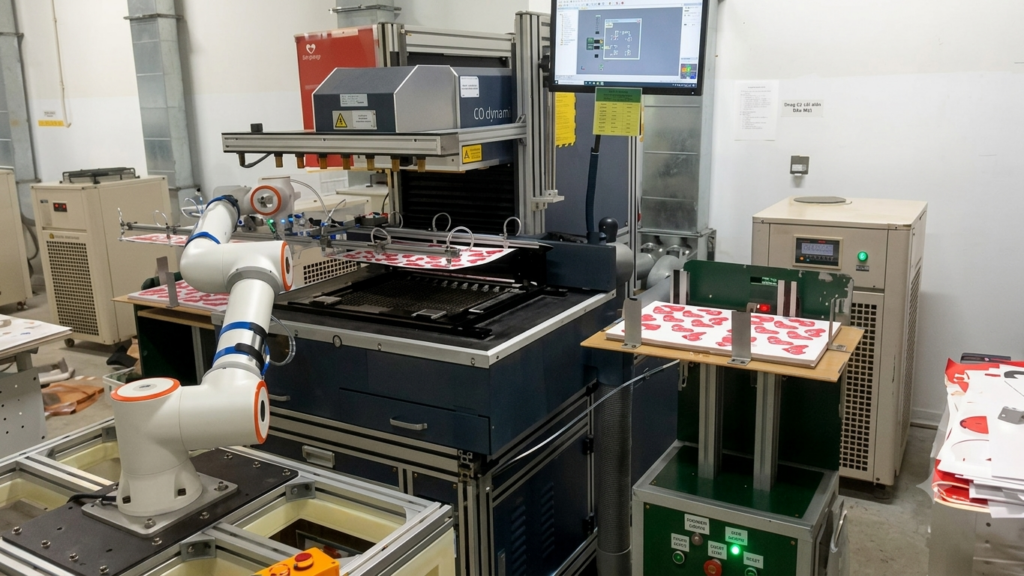
Many manufacturers start from proven, pre-matched parts and complete automation cells rather than sourcing every piece on its own. That lowers integration risk and gives more confidence that the finished system will run as intended.
AI and humanoids: what is real today
It is easy to assume automation still means a robot bolted to the floor, running one fixed motion for its whole service life. Two developments are drawing attention right now — the AI improving today's systems, and the humanoid robots beginning to appear in pilots on production floors. Both are worth understanding, and both are easy to overestimate.
AI improves what today's automation can do
The most useful AI in material handling improves the systems you already understand rather than replacing them. It is the machine vision that lets a guided arm find a randomly oriented part in a bin, the software that helps a gripper adapt to a part it has not handled before, and the logic that lets a cell absorb small variations instead of halting. Used well, it widens the range of tasks a robot can handle reliably.
But AI is an enabler, not a shortcut. A vision-guided cell still needs sound mechanical design, careful integration, and real process work to run dependably. The AI sharpens the result; it does not remove the engineering. The projects that succeed still start with a well-defined task and a proven system around it, with AI improving performance rather than standing in for the fundamentals.
Humanoids are promising, but mostly still in pilots
Humanoid robots have generated real excitement, and the long-term appeal is easy to see: a single platform that works in spaces built for people, with no floor reconfiguration. A handful of two-legged platforms have moved into pilot programs and limited deployments, handling totes and transferring parts in warehouses and automotive plants. That is a true step beyond the demonstration videos of a few years ago.

For now, though, these remain early-stage deployments with real questions attached. Reliability, uptime, real-world economics, and the ability to scale beyond a single cell are all still being proven. High-speed and sub-millimeter work stays firmly with fixed and collaborative robots, and for the repetitive, high-volume tasks this guide covers, a cobot, industrial robot arm, or AMR is still faster, cheaper, and more precise.
Where this leaves your next project
The practical takeaway does not change. For most material handling applications today, proven technologies — industrial robots, cobots, and AMRs — remain the right choice, and the framework in this guide still applies: judge the task, match the technology, prove the return. Treat AI and humanoids as developments worth watching, not reasons to wait. As they mature, that same disciplined approach will tell you when one of them finally fits your floor.
Not sure where to start? Book a free consultation with an RBTXpert. An automation specialist can review your application, walk through options, and help you judge whether automation is the right call before you commit.


