The linear bearing decision engineers get wrong: why sliding bearings deserve a second look
For decades, recirculating ball bearing guides have been the default choice in linear motion system design. They are well understood, widely available, and carry an almost reflexive assumption of superiority. But that assumption deserves scrutiny. In a growing number of real-world applications — environments defined by contamination, washdown requirements, noise constraints, or weight budgets — self-lubricating polymer sliding systems offer a more practical, reliable, and cost-effective solution. Engineers who select ball bearing systems without seriously evaluating these factors may be over-engineering their designs at the expense of performance, uptime, and long-term cost.
This post examines where sliding linear bearing technology, specifically drylin® polymer linear guides from igus®, delivers clear advantages over recirculating ball bearing systems — and why engineers should make that evaluation deliberately, not by default.

The fundamental difference between sliding and rolling motion
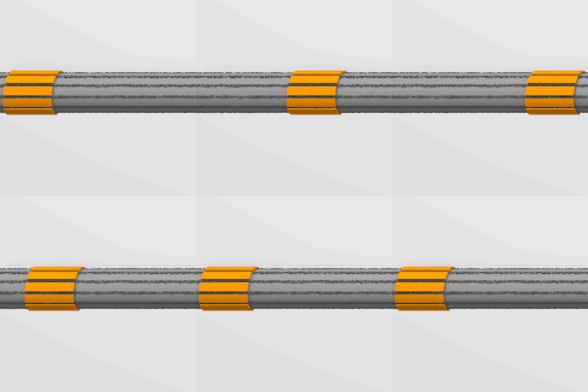
Recirculating ball bearing linear guides operate on rolling elements — steel balls that circulate in a closed loop between the carriage and the rail. This rolling motion reduces contact friction and allows for high speed and load capacity, but it also introduces mechanical complexity. The system requires tight tolerances, precision ground rails, and consistent lubrication to function as designed. More components mean more potential failure points.
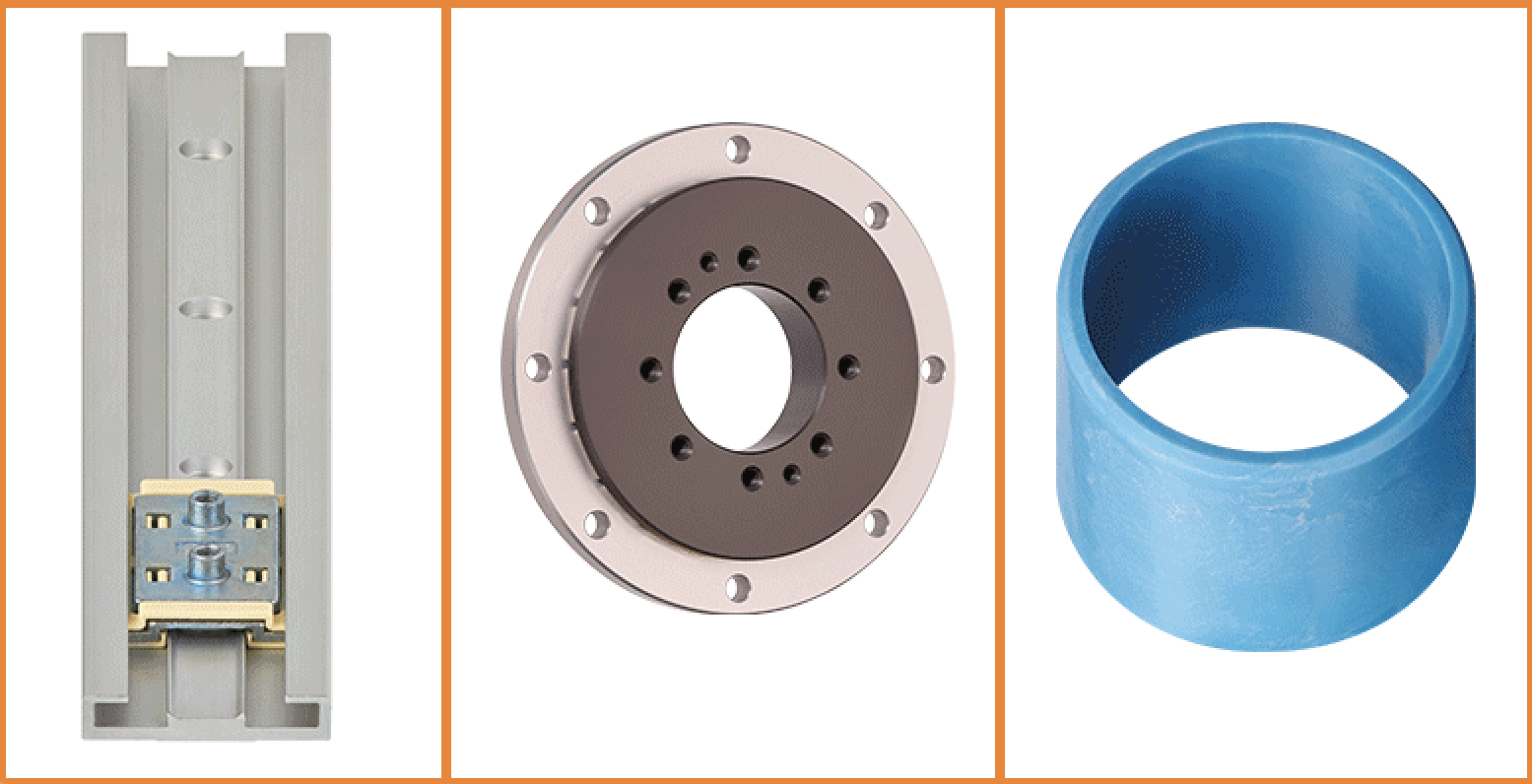
Sliding linear bearings operate on an entirely different principle. The carriage slides directly along the rail surface, with no rolling elements and no recirculation mechanism. drylin® guides use high-performance polymer liners as the sliding interface.
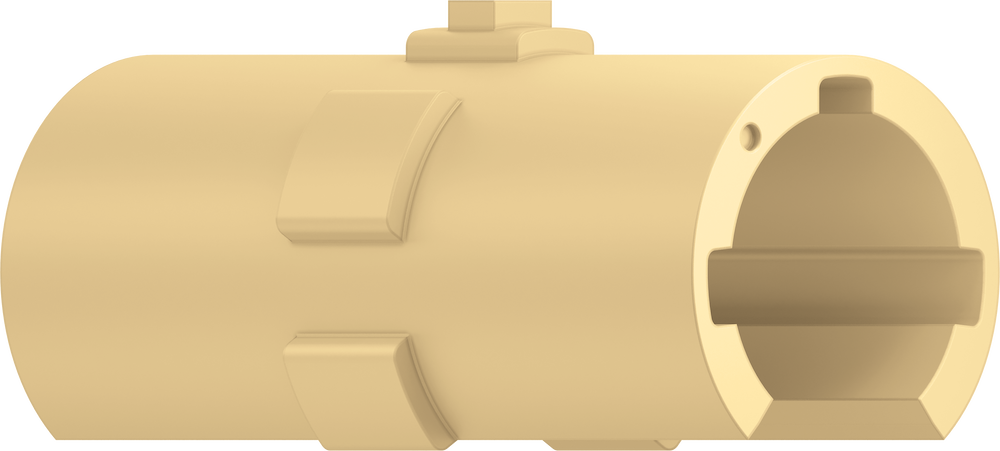
The result is a mechanically simpler system with fewer components, no rolling element fatigue, and no lubrication circuit to maintain. The design implications are significant: sliding systems are inherently more tolerant of contamination, require less precision in installation, and eliminate the maintenance demands associated with rolling element systems.
Friction myths in linear motion systems
The most persistent assumption in linear motion engineering is that rolling always equals lower friction. This is worth challenging directly.
It is true that rolling contact generally produces lower dynamic friction than sliding contact under ideal conditions. But ideal conditions are not the norm in industrial environments. The friction advantage of ball bearing systems depends heavily on consistent lubrication, clean operating conditions, and proper preload. When any of those conditions degrade — and in real applications, they routinely do — the friction advantage narrows or disappears entirely.
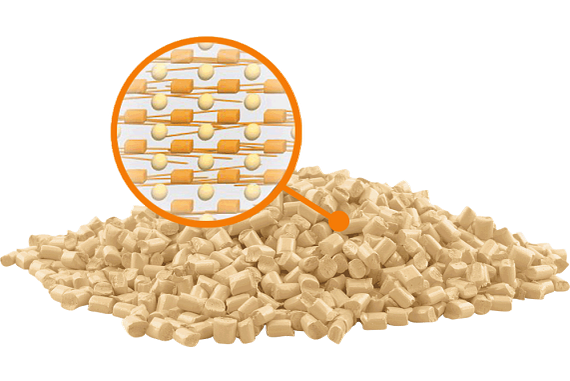
Advances in self-lubricating polymer materials have further closed this gap. drylin® polymer liners are engineered to provide lubrication from within the material itself, eliminating the need for external grease or oil. In applications where contamination, maintenance intervals, or environmental exposure are factors, the practical friction performance of a polymer sliding system can be entirely comparable to a ball bearing system operating under compromised conditions.
More importantly, friction is rarely the only design factor — and in many applications, it is not the deciding factor at all. Load capacity, noise, weight, contamination resistance, and maintenance requirements often carry equal or greater weight in the selection decision. Engineers who reduce the sliding vs. rolling question to friction alone are asking the wrong question.
Performance comparison: drylin® vs. recirculating ball bearing systems
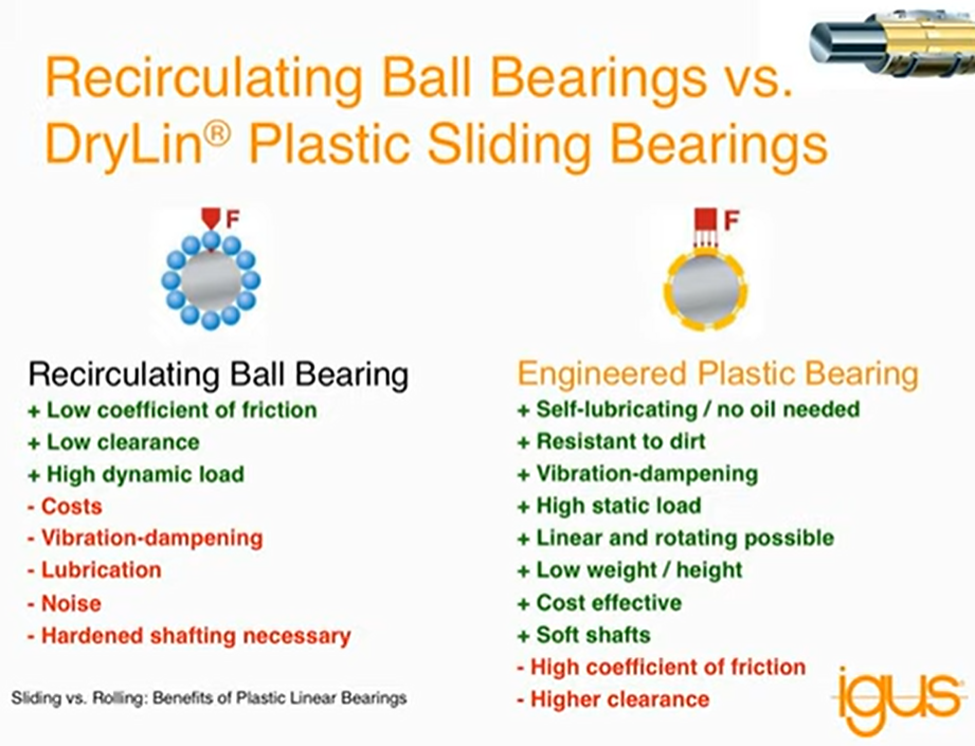
When engineers evaluate linear bearing systems, they typically assess several performance characteristics. Here is how polymer sliding systems compare across those categories:
- Load capacity and system rigidity: Recirculating ball bearing systems generally offer higher load capacity and greater rigidity under heavy loads. For applications where maximum load capacity is the primary requirement, ball bearing systems are ideal. drylin® systems are well suited to light and moderate load applications.
- Speed and acceleration: Ball bearing systems perform well at high speeds and high acceleration. Sliding systems are more appropriate for moderate speed applications where contamination or maintenance constraints are the governing design criteria.
- Noise and vibration: Polymer sliding systems run quietly. The absence of rolling elements eliminates the noise and vibration characteristics associated with recirculating ball systems, making drylin® guides an easy choice in noise-sensitive environments.
- Weight: Polymer linear guides are much lighter than their steel ball bearing counterparts — an advantage in lightweight automation, robotics, and portable equipment design.
- Wear behavior and service life: drylin® polymer liners are designed for predictable, gradual wear. In clean, moderate-load applications, service life is long and wear behavior is consistent. In contaminated environments, sliding systems offer a distinct durability advantage because there are no rolling elements to jam, pit, or seize.
Maintenance, lubrication, and contamination considerations
Recirculating ball bearing systems require lubrication. Grease and oil must be applied at regular intervals to maintain the rolling interface, protect against corrosion, and prevent premature wear. In practice, this means scheduled maintenance, downtime, and the ongoing risk of under-lubrication or over-lubrication.
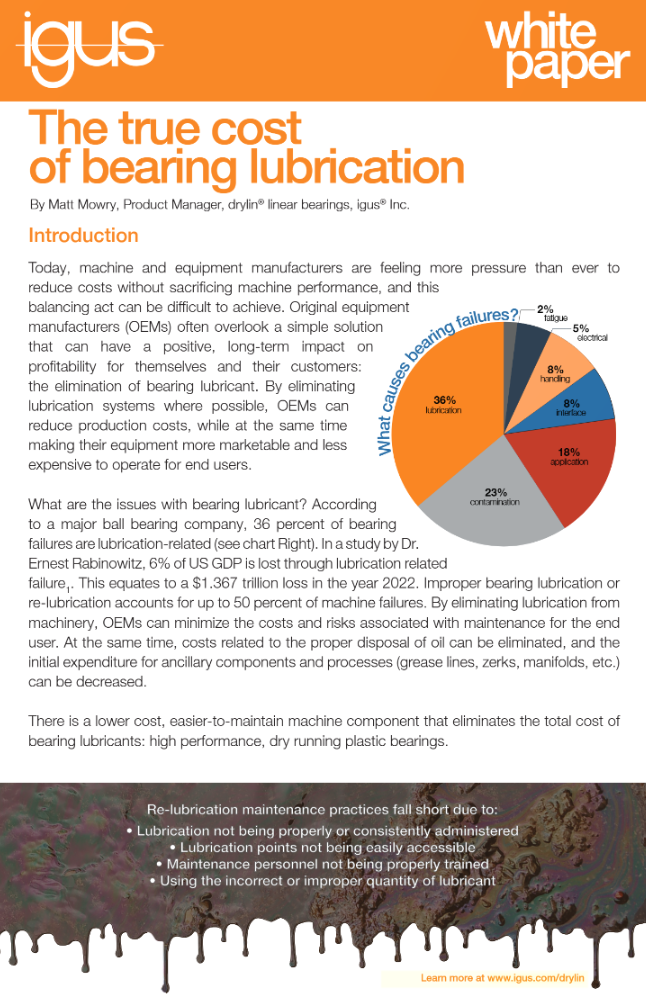
In environments where lubricant contamination is a concern — such as food processing, medical equipment, and cleanroom applications — the lubrication requirement of ball bearing systems creates a genuine engineering problem.
It also creates a contamination risk in the opposite direction. In dusty or particle-heavy environments, grease acts as a collection surface for airborne debris. Over time, contaminated grease forms an abrasive paste that accelerates wear and shortens system life. Engineers who have maintained ball bearing linear guides in woodworking, packaging, or machining environments should be familiar with this failure mode.
drylin® polymer sliding systems are self-lubricating and maintenance-free. There is no grease to apply, no lubrication interval to track, and no contamination pathway associated with external lubricants. In environments with washdown requirements, the absence of grease also simplifies cleaning protocols. These are not marginal benefits — in the right application, they represent a fundamental improvement in system reliability and operating cost.
Applications where sliding linear bearings excel
The following environments and industries consistently favor sliding technology over rolling systems:
- Dusty or particle-heavy environments such as woodworking, packaging, and machining, where airborne debris contaminates lubricant and compromises ball bearing performance.
- Wet or washdown environments, where water ingress and cleaning cycles create corrosion and lubrication challenges for steel rolling element systems.
- Food and beverage processing equipment, where lubricant contamination is a regulatory and safety concern.
- Medical and laboratory devices, where cleanliness, light weight, and quiet operation are design requirements.
- Noise-sensitive applications, where the vibration and sound generated by recirculating ball systems are unacceptable.
- Lightweight automation and robotics, where reduced system weight directly improves performance.
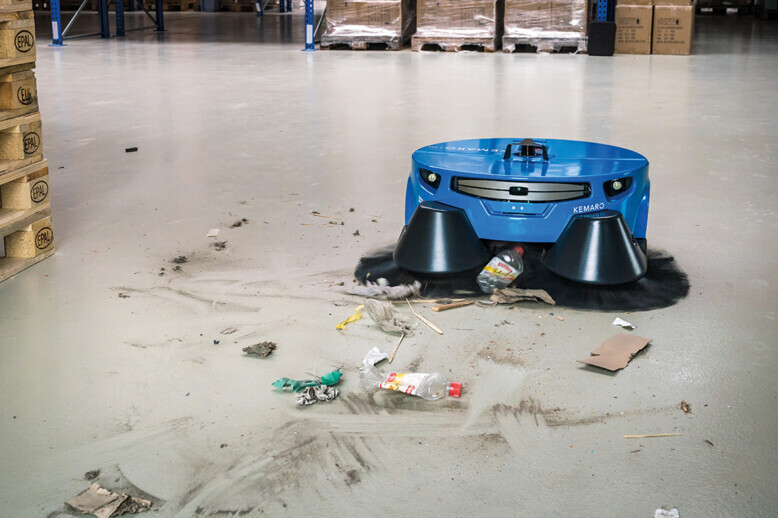
This last category is illustrated well by the K900 autonomous industrial cleaning robot from KEMARO AG. The K900 cleans floors independently in warehouses, production facilities, and industrial plants — including areas that are difficult or hazardous for people to access. The robot's trolley handle is guided using a drylin® T linear guide from igus®.
KEMARO AG selected drylin® specifically because the self-lubricating guides require no external lubrication, which means no dust accumulation on the guide surfaces and no abrasive paste formation. The result is a quieter, lighter, more robust system that requires less maintenance — a set of outcomes that recirculating ball bearing guides could not have delivered as cleanly in this application.
Design considerations when selecting linear bearing technology
When evaluating sliding versus rolling linear guides, engineers should work through the following factors systematically:
- What are the load and speed requirements, and do they fall within the operating range of a polymer sliding system?
- What is the operating environment — clean or contaminated, wet or dry, temperature-controlled or variable?
- What are the maintenance constraints — is scheduled lubrication practical, or does the application demand a maintenance-free solution?
- Is weight a design constraint?
- Are noise or vibration levels a concern?
Where contamination resistance, maintenance-free operation, low noise, or reduced weight are governing criteria, a drylin® polymer sliding solution is very likely the optimal design choice. Engineers who work through this evaluation honestly — rather than defaulting to ball bearings because that is what the last design used — will find that sliding technology earns its place in a wider range of applications than is commonly assumed.
Conclusion
Recirculating ball bearing systems are good engineering tools. So are polymer sliding systems. The difference is that one of them has been over-relied upon for years, and the other has been underestimated. drylin® linear guides offer a proven alternative that outperforms ball bearing systems in a well-defined and growing set of applications. Maintenance-free operation, contamination resistance, quiet running, and reduced weight are not secondary considerations — in many machine designs, they are the primary ones. Engineers who treat linear bearing selection as a real decision, rather than a default, will build better machines.